Wire Gauge Chart 2026: How to Choose the Right Wire Size for Your Amperage
Match AWG size to amperage fast with this 2026 wire gauge chart. Compare copper vs aluminum ampacity, then calculate your exact amp load now.
Usman Haider
Contributor
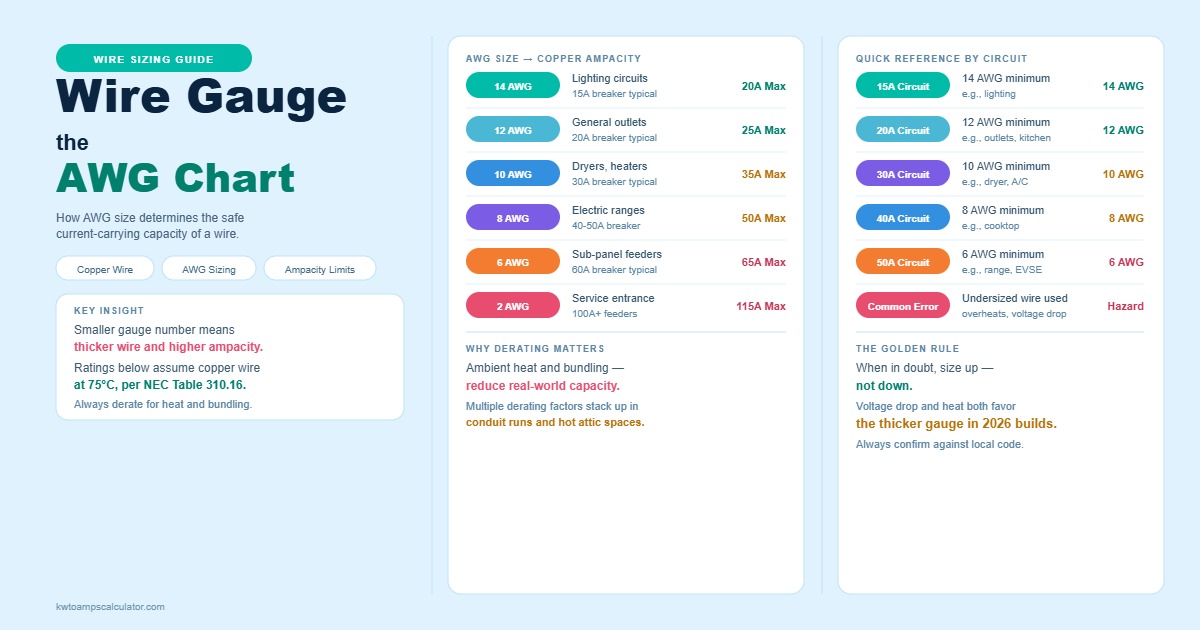
Table of Contents
- What Is a Wire Gauge Chart and How Do You Read It?
- Complete Wire Gauge Chart 2026: AWG Sizes, Diameter, and Amp Ratings
- How to Choose the Right Wire Gauge for Your Amperage
- Wire Gauge Chart by Common Circuit Type
- Copper vs Aluminum Wire Gauge: What Changes on the Chart?
- How to Account for Voltage Drop When Sizing Wire
- What Happens When You Use the Wrong Wire Gauge?
- How to Size Wire for Generators, Solar, and Industrial Loads
- Wire Gauge Selection Quick Reference
- Frequently Asked Questions About Wire Gauge Charts
- Choosing the Right Wire Size in 2026
A wire gauge chart matches your amp load to the correct AWG wire size in one lookup. Find your circuit's amperage, scan the ampacity column, and read across to the smallest wire that meets or exceeds that number. This 2026 wire gauge chart covers copper and aluminum conductors from 14 AWG through 4/0 AWG, with diameter, ampacity, and typical applications for each size.
Electricians, solar installers, and DIY homeowners all rely on the same wire gauge chart logic. Get the amp number right first, then let the chart do the rest of the work.
What Is a Wire Gauge Chart and How Do You Read It?
A wire gauge chart lists 3 core values for every American Wire Gauge (AWG) size: diameter, ampacity, and resistance. Diameter tells you the physical thickness of the conductor. Ampacity tells you the maximum safe current in amps. Resistance tells you how much voltage the wire loses over distance.
AWG uses an inverse numbering scale. A lower AWG number always means a thicker wire. 14 AWG measures 1.63 mm (0.064 inches) across, while 4/0 AWG measures 11.68 mm (0.46 inches) across. That gap explains why a 14 AWG lamp cord and a 4/0 AWG service cable look nothing alike.
Named wire types on any wire gauge chart include THHN, THWN, NM-B, and USE-2 conductors. Each insulation type carries a different temperature rating, so a single 12 AWG conductor can show 3 separate ampacity numbers depending on whether it runs at 60°C (140°F), 75°C (167°F), or 90°C (194°F).
How AWG Numbers Relate to Wire Diameter
Every 3-gauge decrease doubles the cross-sectional area of the conductor. Every 6-gauge decrease doubles the diameter itself. A 12 AWG wire measures twice the diameter of an 18 AWG wire. This doubling pattern lets you estimate a middle size on the wire gauge chart even when the exact number is not printed on the table. Named gauge families grouped this way include 18-16-14 for low-power electronics, 12-10-8 for household branch circuits, and 4-2-1/0 for feeders and service entrance cable.
How to Read the Diameter and Resistance Columns
To read the diameter and resistance columns, you match your planned wire run length against the resistance value listed in ohms per 305 meters (1,000 feet). Longer runs lose more voltage, so a wire that passes the ampacity test can still fail the voltage drop test on a run past 30 meters (100 feet). Resistance values on a standard wire gauge chart are measured at 20°C (68°F), and resistance climbs roughly 0.4 percent for every degree Celsius above that baseline.
How to Read the Ampacity Column
To read the ampacity column, you find your circuit's amp draw and pick the first AWG size whose rating meets or beats that number. Never round down to a smaller wire to save money on copper or aluminum. Ampacity numbers on a wire gauge chart already assume a specific installation method, so a wire buried in insulation or bundled with 5 or more other conductors needs a derating adjustment from NEC Table 310.15.
Complete Wire Gauge Chart 2026: AWG Sizes, Diameter, and Amp Ratings
The table below lists 10 standard AWG sizes with copper ampacity at the 60°C (140°F) and 75°C (167°F) ratings, the columns most electricians reference for NM-B, THWN, and THHN conductors under NEC Table 310.16.
|
AWG Size |
Diameter mm (in) |
Copper Amps 60C |
Copper Amps 75C |
Typical Application |
|
14 |
1.63 mm (0.064 in) |
15A |
20A |
Lighting circuits, 15A outlets |
|
12 |
2.05 mm (0.081 in) |
20A |
25A |
20A kitchen and workshop outlets |
|
10 |
2.59 mm (0.102 in) |
30A |
35A |
Dryers, water heaters, window A/C units |
|
8 |
3.26 mm (0.128 in) |
40A |
50A |
Ranges, ovens, large appliances |
|
6 |
4.11 mm (0.162 in) |
55A |
65A |
HVAC equipment, sub-panel feeders |
|
4 |
5.19 mm (0.204 in) |
70A |
85A |
Feeder cable, Level 2 EV chargers |
|
2 |
6.54 mm (0.258 in) |
95A |
115A |
Service feeders, large motors |
|
1/0 |
8.25 mm (0.325 in) |
N/A |
150A |
Service entrance cable |
|
2/0 |
9.27 mm (0.365 in) |
N/A |
175A |
Sub-panel feeders |
|
4/0 |
11.68 mm (0.46 in) |
N/A |
230A |
Main service entrance |
These ampacity values assume free air or standard conduit fill with 3 or fewer current-carrying conductors. Bundled conductors, high ambient temperatures, and long conduit runs all reduce the safe amperage below the figures listed here.
Named sizes worth memorizing from this wire gauge chart are 14 AWG, 12 AWG, 10 AWG, and 6 AWG, since these 4 sizes cover most residential lighting, outlet, appliance, and sub-panel circuits. Sizes larger than 4/0 AWG switch to kcmil (thousand circular mil) units and appear on separate service-entrance and utility charts rather than the standard AWG table.
How to Choose the Right Wire Gauge for Your Amperage
To choose the right wire gauge for your amperage, you calculate total amp load, apply the NEC continuous-load rule, then match the result to the wire gauge chart ampacity column.
How to Calculate Your Circuit's Amp Load
To calculate your circuit's amp load, you divide total watts by system voltage using the formula amps equals watts divided by volts. Common household loads such as microwaves, space heaters, and window air conditioners list their wattage directly on the rating label. Convert that wattage instantly with a watts to amps calculator instead of doing the division by hand.
How to Apply the NEC 125 Percent Continuous Load Rule
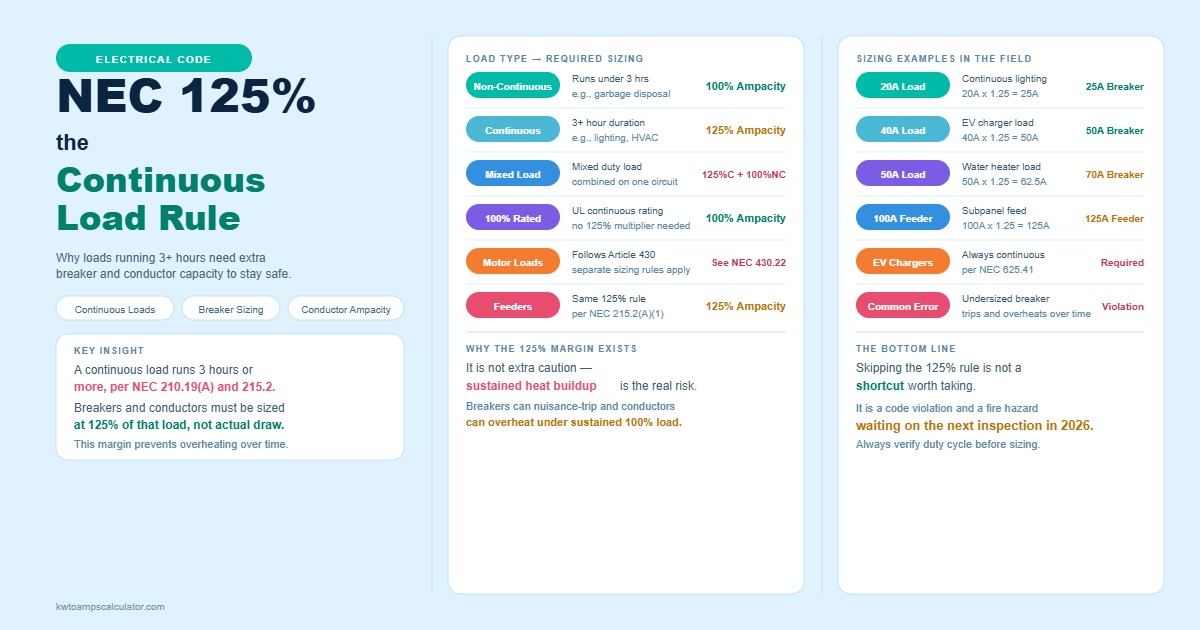
To apply the NEC 125 percent rule, you multiply any load that runs 3 hours or longer by 1.25 before you pick a wire size. A 16A continuous load, such as a Level 2 EV charger or a countertop water heater, needs wire and a breaker rated for 20A, not 16A. This rule appears in NEC Article 210.19 and NEC Article 625 for electric vehicle charging equipment.
A second example makes the math clear. A 40A EV charger classified as a continuous load needs 40 multiplied by 1.25, which equals 50A. That 50A figure, not the 40A nameplate rating, is the number you match against the wire gauge chart, which points to 6 AWG copper at the 75°C column.
Wire Gauge Chart by Common Circuit Type
Wire Size for 15 Amp and 20 Amp Circuits
The wire size for a 15A circuit is 14 AWG copper. The wire size for a 20A circuit is 12 AWG copper. Standard 15A circuits power lamps, ceiling fans, and smoke detectors. Standard 20A circuits power kitchen counters, bathroom outlets, and garage workshops.
Wire Size for 30 Amp, 40 Amp, and 50 Amp Circuits
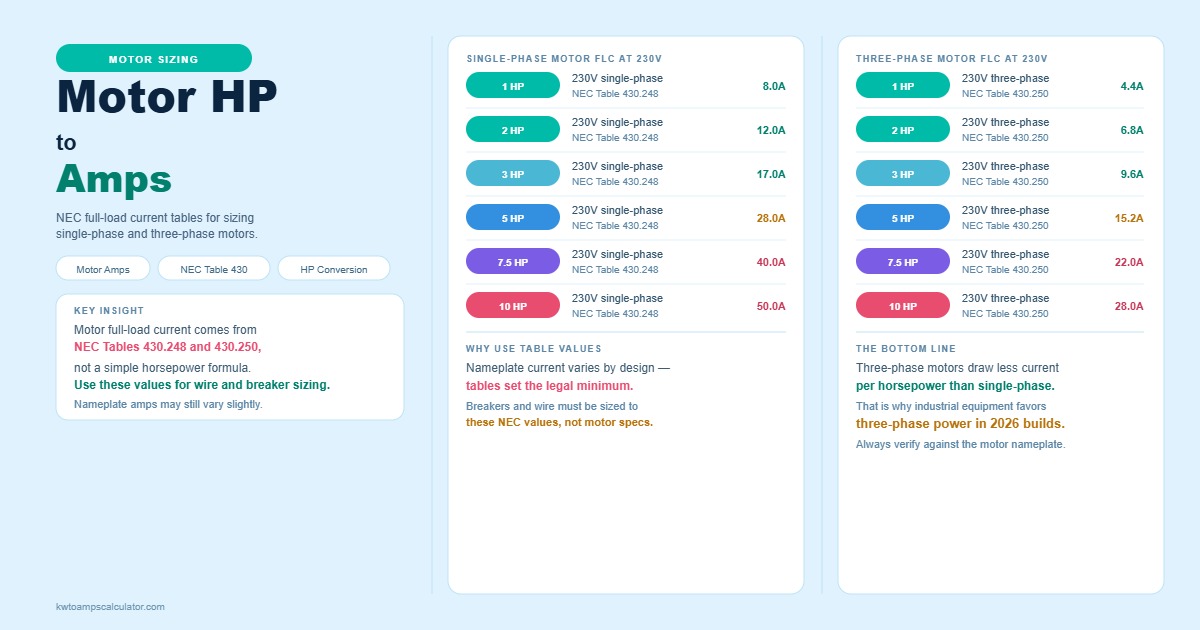
The wire size for a 30A circuit is 10 AWG copper. The wire size for a 40A circuit is 8 AWG copper. The wire size for a 50A circuit is 6 AWG copper. These 3 sizes commonly serve clothes dryers, electric water heaters, kitchen ranges, and Level 2 EV chargers.
Wire Size for Sub-Panels and Service Entrance Cable
The wire size for a 100A sub-panel is 2 AWG copper at the 75°C column, while a 200A main service entrance typically calls for 4/0 AWG copper or 250 kcmil aluminum. Named installations that rely on these larger sizes include detached garages, workshop sub-panels, backyard studios, and full-house service upgrades. Local code offices often add a required inspection step for any of these 3 installation types before the utility connects power.
Copper vs Aluminum Wire Gauge: What Changes on the Chart?
Copper wire carries more current than aluminum wire at the same AWG size. Aluminum needs 2 gauge sizes larger to match copper's ampacity. A 2 AWG aluminum feeder matches a 4 AWG copper feeder for a 90A load.
Named requirements for aluminum installations include anti-oxidant compound, AL-rated lugs, and periodic torque checks on every terminal. Aluminum costs less per foot and weighs less per foot, reasons utility companies and solar installers still specify it for long feeder runs.
Copper conducts electricity roughly 61 percent better than aluminum, which explains the 2-gauge size penalty on any wire gauge chart. Aluminum also expands and contracts more with temperature changes than copper, a factor that loosens screw terminals over years of use unless an installer rechecks torque values on a fixed schedule, such as every 2 years for a sub-panel feeder.
How to Account for Voltage Drop When Sizing Wire
To account for voltage drop, you multiply 2 times the one-way length times the current times the resistance per foot, then compare that figure against supply voltage. The formula reads: Voltage Drop = 2 x Length (ft) x Current (A) x Resistance (ohms/ft).
For example, a 10A load on 16 AWG wire (resistance 4.02 ohms per 305 meters/1,000 feet) over 15 meters (50 feet) produces a drop of roughly 4V on a 12V system, a 33 percent loss that stalls motors and dims lights. Stepping up to 10 AWG wire cuts that drop to about 1V, an 8 percent loss within the 3 percent target the NEC recommends for branch circuits.
Three-phase motors and industrial feeders use a modified voltage drop formula that drops the factor of 2 and adds a square-root-of-3 multiplier. Run the load through a three-phase power calculator before you finalize wire size for a 3-phase panel feeder or motor circuit.
Standard 120V and 240V AC branch circuits follow a simpler target. The NEC recommends keeping voltage drop under 3 percent for the branch circuit alone and under 5 percent for the branch circuit plus feeder combined. A 20A load on 12 AWG wire over 23 meters (75 feet) at 120V produces a drop near 2.4 percent, comfortably inside the NEC target without upsizing the conductor.
What Happens When You Use the Wrong Wire Gauge?
Overheating and Fire Risk
Undersized wire overheats whenever it carries more current than its rated ampacity allows. Melted insulation, discolored outlets, and a breaker that trips repeatedly are 3 early warning signs of an undersized circuit. In enclosed spaces such as attics, wall cavities, and equipment enclosures, that heat has nowhere to escape, and the risk of an arc fault or fire climbs sharply.
Voltage Drop and Equipment Damage
Undersized wire on long runs causes voltage drop that damages sensitive equipment over time. Motors, well pumps, and electronic controls draw higher current at reduced voltage, which generates extra heat inside the equipment itself. A motor running consistently below its rated voltage wears out its windings faster and can fail years ahead of schedule.
Connector and Terminal Failure
Undersized wire heats up first at its weakest connection points. Screw terminals, crimp connectors, and push-in fittings all add contact resistance, so these junctions warm before the rest of the run does. Discolored outlets, warm cover plates, and a faint burning smell near a receptacle are 3 signs that a connector is failing under an oversized load.
How to Size Wire for Generators, Solar, and Industrial Loads
To size wire for a generator, solar inverter, or industrial panel, you convert the equipment's kW or kVA rating into amps before you touch the wire gauge chart. Standby generators, solar inverters, and UPS systems all list their rating in kW or kVA rather than amps directly, so the conversion step comes first.
Apply the same NEC 125 percent rule used for any continuous load once the current figure is known, then select a conductor from the wire gauge chart above.
Named equipment categories that need this conversion step include standby generators for whole-home backup, solar inverters for rooftop and ground-mount arrays, battery storage systems for off-grid cabins, and 3-phase industrial motors on plant floors. A 10 kW solar inverter at 240V single-phase draws roughly 42A, a figure that lands squarely on 6 AWG copper once the continuous-load multiplier is applied.
Wire Gauge Selection Quick Reference
|
Task |
Timing |
Method |
Difficulty |
|
Identify circuit amp load |
5 minutes |
Read the appliance nameplate or use an amps calculator |
Easy |
|
Apply NEC 125% continuous load rule |
2 minutes |
Multiply amp load by 1.25 |
Easy |
|
Match amps to wire gauge chart |
5 minutes |
Compare load against the ampacity column |
Easy |
|
Check voltage drop for long runs |
10 minutes |
Apply the voltage drop formula |
Moderate |
|
Confirm copper or aluminum sizing |
5 minutes |
Add 2 gauge sizes for aluminum conductors |
Easy |
|
Verify local code and permit rules |
15 minutes |
Contact the local building department |
Moderate |
|
Schedule final wiring inspection |
1 to 2 weeks |
Book a licensed electrician visit |
Moderate |
Frequently Asked Questions About Wire Gauge Charts
Is 12 AWG wire the same as 12 gauge wire?
Yes. 12 AWG wire and 12 gauge wire name the identical American Wire Gauge size. Suppliers and electricians use the 2 terms interchangeably on labels, spec sheets, and invoices.
Can 14 AWG wire handle a 20A circuit?
No. 14 AWG wire is rated for 15A and overheats when placed on a 20A breaker. Swap in 12 AWG copper any time the breaker is rated for 20A.
Does aluminum wire follow the same wire gauge chart as copper?
No. Aluminum wire needs 2 gauge sizes larger than copper to carry the same amperage safely. Always check the aluminum-specific ampacity column rather than reusing copper numbers.
How far can 10 AWG wire run before voltage drop becomes a problem?
10 AWG wire on a 30A, 120V circuit stays under a 3 percent voltage drop for roughly 30 meters (100 feet) one way. Longer runs need a larger gauge such as 8 AWG or 6 AWG, particularly for well pumps and workshop sub-panels set back from the house.
Should a licensed electrician check wire sizing before a project goes live?
Yes. Any circuit tied to a breaker panel needs a final check from a licensed electrician before it carries a real load. Most jurisdictions require a permit and inspection for new circuits, sub-panels, and service upgrades.
Choosing the Right Wire Size in 2026
Picking the right wire size protects your equipment, your budget, and your home from every risk covered in this wire gauge chart. Match your calculated amp load to the ampacity column above, apply the NEC 125 percent rule to continuous loads, and check voltage drop on any run past 15 meters (50 feet). Working with a generator, solar array, or industrial panel? Convert the equipment's kW or kVA rating with our kVA to amps calculator before you buy a single foot of conductor.

About Usman Haider
We are dedicated to providing accurate, easy-to-understand information. Our goal is to help you minimize effort and maximize results.