HP to Amps Calculator 2026: Motor Full-Load Current Guide
Use our free HP to amps calculator to find exact motor full-load current in 2026. Get instant, accurate amps for wiring and breaker sizing today.
Usman Haider
Contributor
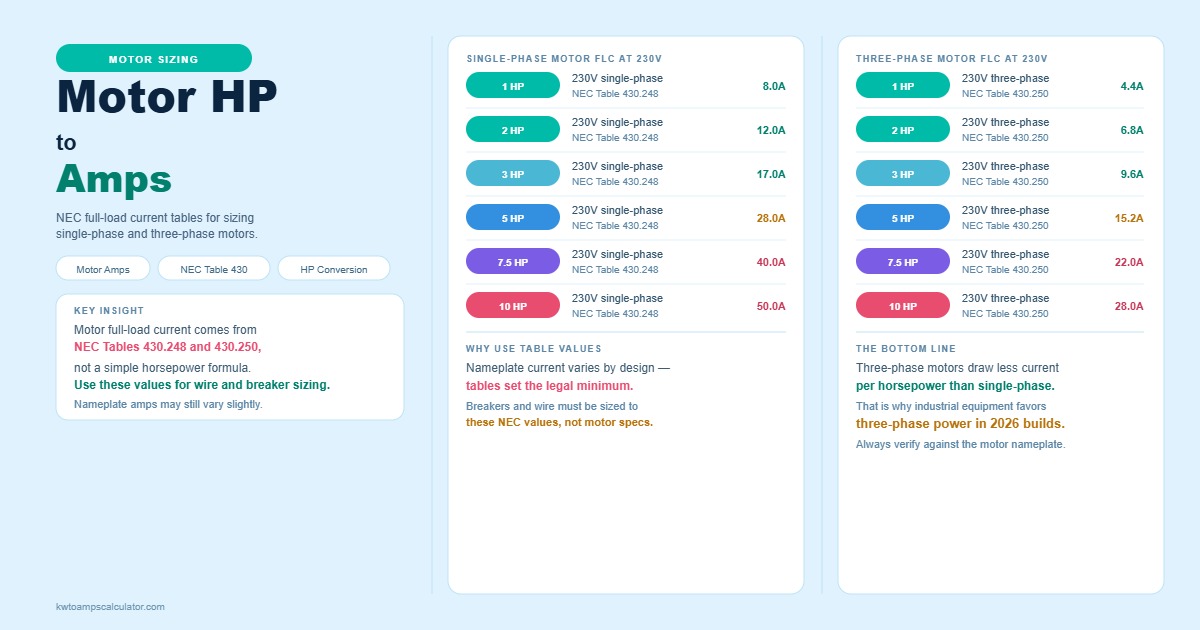
Table of Contents
- What Is an HP to Amps Calculator?
- How to Calculate HP to Amps for Any Motor
- What Factors Change Your Motor's Amp Draw?
- How Long Does It Take to Calculate HP to Amps?
- How to Size Wire and Breakers After Calculating Amps
- What Mistakes Cause Wrong HP to Amps Results?
- How Do You Verify Your HP to Amps Calculator Result?
- Why Do NEC Table Values Differ From Calculated Amps?
- Frequently Asked Questions About HP to Amps Calculators
An HP to amps calculator converts a motor's horsepower (HP) rating into full-load amps (FLA) using voltage, efficiency, and power factor (PF). You multiply horsepower by 746, then divide by voltage, efficiency, and power factor to get the exact current draw in 2026.
Electricians, engineers, and facility managers run an HP to amps calculator before ordering wire, breakers, and starters for 3 motor types: single-phase, three-phase, and DC. Each motor type uses a slightly different version of the formula, and using the wrong version skews your result by 40 percent or more. This guide walks through every formula, shows worked examples with real numbers, and flags the mistakes that cause the most rework on job sites across the US, UK, and Canada.
Most published guides round efficiency and power factor to generic textbook defaults, but real nameplate efficiency swings from 78 percent to 96 percent across common frame sizes in 2026. This guide uses realistic efficiency and power factor ranges pulled from current motor nameplates instead of rounded defaults, so your HP to amps calculator result matches real hardware rather than a rough estimate.
What Is an HP to Amps Calculator?
An HP to amps calculator is a formula-based tool that turns horsepower into full-load amps using four inputs: horsepower, voltage, efficiency, and power factor. Electricians rely on an HP to amps calculator before wiring a motor, because nameplate current is not always available at the design stage, especially on replacement jobs where the old nameplate has worn away. The base formula converts horsepower to watts first: 1 HP equals 746 watts. Dividing watts by voltage, efficiency, and power factor produces the current draw in amps.
A 10 HP motor running three-phase at 460 volts, with 91 percent efficiency and a 0.87 power factor, draws 9.35 amps per phase. Contractors in the United States, United Kingdom, and Canada apply the same HP to amps formula, though standard supply voltages differ: 230 volts and 400 volts in the UK, 208 volts and 480 volts in the US, and 240 volts and 600 volts in Canada. Always confirm local voltage before you run any HP to amps calculation, since a wrong voltage input produces a wrong current result even when every other number is correct.
Motor manufacturers such as Baldor, WEG, and Siemens stamp efficiency and power factor directly on the nameplate. When the nameplate is missing or unreadable, an HP to amps calculator lets you estimate current using typical published values for that horsepower and frame size. Replacement projects benefit most from this approach, since a 20-year-old motor often arrives with a corroded or painted-over nameplate that no longer shows a readable efficiency figure.
How to Calculate HP to Amps for Any Motor
To calculate HP to amps, multiply horsepower by 746, then divide by voltage, efficiency, and power factor. Three-phase motors add 1.732 (the square root of 3) to the denominator, since three conductors share the load instead of two.
How to Calculate HP to Amps for Single-Phase Motors
To calculate HP to amps for a single-phase motor, use this formula: Amps equals HP times 746, divided by voltage times efficiency times power factor. A 2 HP single-phase motor at 115 volts, 84 percent efficiency, and a 0.80 power factor draws 19.3 amps. A larger 5 HP single-phase motor at 230 volts, 87 percent efficiency, and a 0.82 power factor draws 20.9 amps. Single-phase motors power tools such as air compressors, table saws, and small water pumps found in home workshops and light commercial settings.
How to Calculate HP to Amps for Three-Phase Motors
To calculate HP to amps for a three-phase motor, add 1.732 to the denominator: Amps equals HP times 746, divided by voltage times 1.732 times efficiency times power factor. A 25 HP three-phase motor at 460 volts, 92 percent efficiency, and a 0.88 power factor draws 28.2 amps per line. A smaller 5 HP three-phase motor at 230 volts, 89 percent efficiency, and a 0.83 power factor draws 11.8 amps per line.
Confirm your line current with the three-phase power calculator before you order conductors for a new installation. Three-phase motors run heavier loads such as conveyor systems, industrial pumps, and large air compressors across factories, warehouses, and treatment plants.
How to Calculate HP to Amps for DC Motors
To calculate HP to amps for a DC motor, drop the power factor and phase multiplier entirely: Amps equals HP times 746, divided by voltage times efficiency. A 1 HP DC motor at 90 volts and 80 percent efficiency draws 10.4 amps. A 3 HP DC motor at 180 volts and 85 percent efficiency draws 14.6 amps. DC motors appear in equipment such as forklifts, golf carts, and battery-powered winches, where battery voltage stays fixed and power factor never applies.
What Factors Change Your Motor's Amp Draw?
Four factors change your motor's amp draw: voltage, efficiency, power factor, and load percentage. Raising voltage lowers current for the same horsepower, while a low power factor raises it, and running below full load lowers current further.
Efficiency and Power Factor Effects
Efficiency measures how much input electricity a motor converts into mechanical output. A motor rated at 95 percent efficiency wastes less current as heat than a motor rated at 80 percent, even at identical horsepower and voltage. Premium-efficiency motors, sold under labels such as IE3 and IE4 in the UK and NEMA Premium in the US, typically run 3 to 6 percentage points higher than standard-efficiency models of the same horsepower. Power factor measures how much current performs real work against how much current only supports the magnetic field inside the motor windings. A power factor below 0.80 forces a motor to draw more amps for the same horsepower output, which is why utilities in the UK and Canada often charge commercial customers a penalty for low power factor.
Load percentage also shifts amp draw independently of efficiency and power factor. A motor running at 50 percent of its rated load draws noticeably less current than the same motor at 100 percent load, but its efficiency and power factor often drop slightly at partial load. An HP to amps calculator that assumes full load will overstate current on a lightly loaded fan or pump, so note the actual operating load whenever you can measure it.
Voltage and Phase Type Effects
Voltage and phase type change current by fixed, predictable multipliers. Doubling voltage from 230 volts to 460 volts cuts current in half for the same horsepower and load.
Use the kW to volts calculator to check your supply voltage before you run any HP to amps formula on an unfamiliar system. Three-phase motors draw 1.732 times less current than single-phase motors at matching voltage and horsepower, because three conductors share the load instead of two.
How Long Does It Take to Calculate HP to Amps?
Calculating HP to amps by hand takes 1 to 5 minutes, depending on motor type and whether you already know efficiency and power factor. The table below breaks down 6 common tasks by time, method, and difficulty, so you can plan your workflow before a site visit, and so you know which steps to batch together on a multi-motor job.
|
Task |
Time Needed |
Method |
Difficulty |
|
Single-phase HP to amps calculation |
2 minutes |
Amps = (HP x 746) / (V x Eff x PF) |
Easy |
|
Three-phase HP to amps calculation |
3 minutes |
Amps = (HP x 746) / (V x 1.732 x Eff x PF) |
Moderate |
|
DC motor HP to amps calculation |
2 minutes |
Amps = (HP x 746) / (V x Eff) |
Easy |
|
NEC table lookup for FLA |
1 minute |
Table 430.250 or Table 430.248 reference |
Easy |
|
Wire size selection after FLA |
5 minutes |
125 percent FLA rule under NEC 430.22 |
Moderate |
|
Breaker size selection after FLA |
5 minutes |
Up to 250 percent FLA rule under NEC 430.52 |
Moderate |
How to Size Wire and Breakers After Calculating Amps
To size wire after calculating amps, multiply full-load amps by 1.25 for continuous-duty conductors. To size a breaker, multiply full-load amps by up to 2.50 for inverse-time breakers under NEC 430.52. A motor drawing 20 amps needs conductors such as copper THHN or aluminum XHHW rated for at least 25 amps, plus a breaker sized up to 50 amps for inrush protection during startup.
Distance also changes wire sizing after you calculate amps. Runs longer than 100 feet (30 meters) need larger conductors to offset voltage drop along the cable. A run of 150 feet (46 meters) at 20 amps often needs one wire size larger than the 125 percent rule alone suggests, so measure your actual conduit run before ordering material. Starters and thermal overload relays use nameplate FLA, not the NEC table value, so keep both numbers on hand when you order motor control equipment.
UK projects follow BS 7671 for conductor and protective device sizing, while Canadian projects follow CSA C22.1, and both standards apply similar safety margins above calculated full-load current. A contractor working across all 3 countries should confirm the local code edition in force before finalizing wire and breaker orders, since NEC, BS 7671, and CSA C22.1 update on different cycles.
What Mistakes Cause Wrong HP to Amps Results?
3 mistakes cause most wrong HP to amps results: using default efficiency instead of nameplate efficiency, forgetting the 1.732 multiplier on three-phase motors, and mixing line-to-line voltage with line-to-neutral voltage.
Default efficiency values assume a generic 85 percent figure, but real motors range from 78 percent to 96 percent depending on frame size and manufacturer. A calculation built on a wrong 10-point efficiency gap changes your final amps by roughly 10 percent, enough to push a wire size selection in the wrong direction. Forgetting the 1.732 multiplier on a three-phase motor inflates your calculated current by 73 percent, which leads to oversized wire and wasted budget. Line-to-line voltage applies to three-phase systems such as 230/400V and 277/480V networks, while line-to-neutral voltage applies to single-phase circuits such as 120V and 230V branch circuits.
Verify your assumed output against the amps to HP calculator any time your calculated horsepower looks lower or higher than the motor's nameplate rating.
How Do You Verify Your HP to Amps Calculator Result?
Verify your HP to amps calculator result against 2 independent sources: the motor's nameplate FLA and a clamp meter reading taken during full-load operation. Nameplate FLA already accounts for the exact efficiency and power factor of that specific motor, so it outranks any general formula whenever it is available and legible. A clamp meter reading taken while the motor runs at full load confirms both the calculated value and the nameplate figure at the same time, which matters most on older equipment.
A gap above 10 percent between your calculated amps and the nameplate FLA usually points to 1 of 3 causes: worn bearings, an undersized supply voltage, or a motor running below its rated load. A motor running below rated load draws less current than its nameplate FLA, and that pattern is normal and expected on lightly loaded fans and pumps. A motor running above its nameplate FLA under normal load conditions needs inspection before it trips breakers or damages the windings.
Why Do NEC Table Values Differ From Calculated Amps?
NEC table values differ from calculated amps because Table 430.250 and Table 430.248 list standardized full-load current values, not motor-specific nameplate data. The National Electrical Code (NEC) requires you to use these table values for conductor and breaker sizing under section 430.6(A)(1), even when your calculated amps come out lower than the table figure.
Nameplate FLA still governs overload relay settings under NEC 430.32, regardless of what the table shows. A calculated 28.2 amps for a 25 HP motor might show 34 amps in the NEC table, and the table value wins for circuit design in every US jurisdiction that adopts the NEC in 2026. UK and Canadian projects follow equivalent standards, BS 7671 and CSA C22.1, which apply similar margins above calculated full-load current for conductor and protection sizing.
Frequently Asked Questions About HP to Amps Calculators
Does horsepower equal amps directly?
No. Horsepower measures mechanical output power, while amps measure electrical current, and you need voltage, efficiency, and power factor to convert one into the other. A 1 HP motor can draw anywhere from 5 amps to 16 amps depending on those 3 remaining inputs.
Can you use one HP to amps calculator for both single-phase and three-phase motors?
No. Single-phase and three-phase motors use different formulas, and three-phase motors include a 1.732 multiplier that single-phase motors skip entirely.
Is nameplate FLA more accurate than a calculated amp value?
Yes. Nameplate FLA reflects the manufacturer's actual test data, while a calculated value only estimates current from typical efficiency and power factor figures. Use nameplate FLA whenever the plate is legible, and reserve calculated values for design work before the motor arrives on site.
Do you need power factor to calculate DC motor amps?
No. DC motors carry no power factor, since power factor only applies to alternating current systems with reactive loads.
Should you round up FLA before ordering a breaker?
Yes. Round FLA up to the next standard breaker size under NEC 240.6, since breakers are not manufactured in every exact amp value.
Calculating HP to amps by hand works well for one motor, but a project with dozens of motors needs faster, more consistent results. Run your own numbers now with the HP to amps calculator and get exact full-load amps in seconds, ready for your 2026 wiring plans.
About Usman Haider
We are dedicated to providing accurate, easy-to-understand information. Our goal is to help you minimize effort and maximize results.