NEC 125% Continuous Load Rule: How to Size Circuit Breakers Correctly in 2026
Learn the NEC 125% Continuous Load Rule and size breakers correctly in 2026. Avoid nuisance tripping. Calculate your load now.
Usman Haider
Contributor
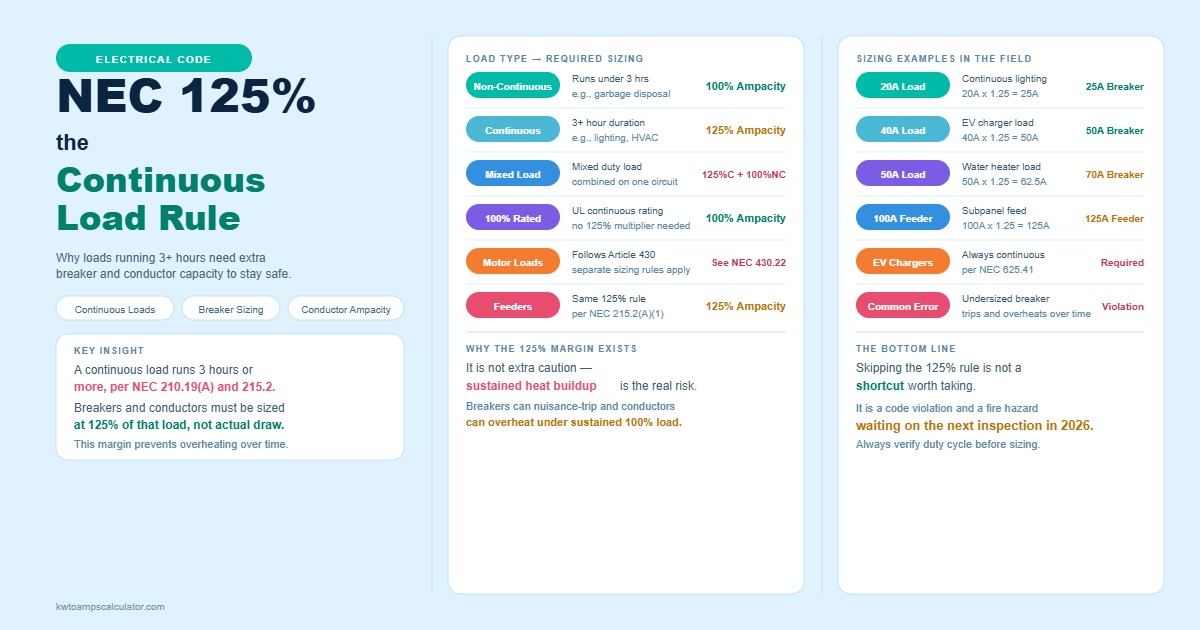
Table of Contents
- What Is the NEC 125% Continuous Load Rule?
- How to Identify a Continuous Load Under the NEC
- How to Calculate Breaker Size Using the NEC 125% Continuous Load Rule
- How to Size a Subpanel or Home Addition Circuit Using the 125% Rule
- Why Circuit Breakers Cannot Carry 100% of Rated Current Continuously
- How the NEC 125% Rule Applies to Conductors, Not Just Breakers
- When the 100%-Rated Breaker Exception Applies
- How to Size a Breaker for an EV Charger Under the NEC 125% Rule
- Common Mistakes When Applying the NEC 125% Continuous Load Rule
- Quick-Reference Table for Continuous Load Sizing Tasks
- Frequently Asked Questions About the NEC 125% Continuous Load Rule
- Conclusion
The NEC 125% Continuous Load Rule requires you to size circuit breakers and conductors at 125% of any continuous load current. This 25% margin stops standard breakers from overheating during long-duration operation in 2026 installations.
You apply this rule whenever a load runs at maximum current for 3 hours or more. The National Electrical Code (NEC) defines this load type in Article 100 and enforces the sizing requirement in sections 210.20(A) and 215.3.
What Is the NEC 125% Continuous Load Rule?
The NEC 125% Continuous Load Rule states that a breaker or fuse must carry 100% of the noncontinuous load plus 125% of the continuous load. A 20A continuous load therefore requires a breaker rated for at least 25A. You calculate this figure by multiplying the continuous portion of the load by 1.25 before you select hardware.
This rule protects 3 components during long operating cycles: circuit breakers, conductors, and panelboard terminations. Standard thermal-magnetic breakers generate internal heat, and that heat accumulates when a load runs for hours without a break. The 25% margin gives that heat somewhere to go without tripping the device or damaging the wire insulation.
NEC 210.20(A) governs branch circuits, while NEC 215.3 governs feeders, and both sections use identical math. A feeder carrying a 184A continuous load needs an overcurrent protective device (OCPD) rated for at least 230A (184A × 1.25 = 230A). The rule stays consistent across recent NEC cycles, so the 3-hour threshold and 1.25 multiplier remain your fixed reference points on every job in 2026.
How to Identify a Continuous Load Under the NEC
To identify a continuous load, check whether the equipment draws its maximum current for 3 hours or more without interruption. The NEC sets this exact 3-hour threshold in Article 100, and it never treats the figure as an estimate.
You classify a load as noncontinuous when the equipment cycles on and off, or when its maximum draw lasts less than 3 hours per operating period. A commercial dishwasher running 20-minute cycles qualifies as noncontinuous, while a walk-in freezer compressor running for hours at a stretch qualifies as continuous. This classification decision comes before any breaker math, since the wrong classification changes every later calculation.
Continuous Load Examples in Residential Circuits
Residential continuous loads include 3 common categories: electric water heaters, electric vehicle (EV) chargers, and permanently installed space heaters. Each device draws full current for hours once activated, so you must apply the 1.25 multiplier to every one of them.
A homeowner adding a workshop subpanel or a hot tub circuit should treat the pump and heater elements as continuous loads whenever the equipment runs unattended for 3 hours or more. Hot tub heaters commonly draw 11A to 30A continuously, depending on the model and voltage, so the breaker and wire size both scale with that draw.
Continuous Load Examples in Commercial Circuits
Commercial continuous loads include store lighting circuits, rooftop HVAC compressors, and illuminated signage that stays lit for entire business shifts. A commercial lighting circuit pulling 40A for 8 hours qualifies as continuous, and it needs a breaker rated for at least 50A. Confirm compressor draw first with our motor amp calculations tool before you size the breaker.
Restaurants, warehouses, and office towers each add their own continuous loads: walk-in refrigeration compressors, rooftop exhaust fans, and emergency egress lighting. Every one of these categories runs long enough to trigger the 125% multiplier during a typical operating day, so a commercial load schedule should flag each one before the panel schedule gets finalized.
How to Calculate Breaker Size Using the NEC 125% Continuous Load Rule
To calculate breaker size under the NEC 125% Continuous Load Rule, multiply the continuous load current by 1.25, then round up to the nearest standard breaker size. This 3-step process applies to branch circuits and feeders alike.
Step 1: Calculate the Continuous Load Current
You measure or calculate the continuous current draw first, using the equipment nameplate or a documented load calculation. A 16A continuous load, for example, becomes your starting figure for every later step. Convert nameplate power ratings using our watts to amps calculator when the nameplate lists watts instead of amps.
Step 2: Apply the 1.25 Multiplier
You multiply the continuous current by 1.25 to find the minimum required breaker and conductor rating. 16A × 1.25 = 20A, which becomes your minimum threshold before you check standard breaker sizes.
Step 3: Select the Next Standard Breaker Size
You select the next standard breaker size listed in NEC 240.6(A) that meets or exceeds your calculated figure. A calculated value of 27.5A rounds up to a 30A breaker, since manufacturers do not produce a 27.5A standard breaker.
A second worked example clarifies the pattern further. A 22A continuous load produces a calculated minimum of 27.5A (22A × 1.25 = 27.5A), and the next standard size above 27.5A is 30A. You repeat this same 3-step sequence for every continuous load on a panel schedule, including mixed panels that combine continuous and noncontinuous circuits.
How to Size a Subpanel or Home Addition Circuit Using the 125% Rule
To size a subpanel feeder for a home addition, add every continuous load at 125% and every noncontinuous load at 100%, then total both figures together. A workshop subpanel feeding a 25A continuous dust collector and a 15A noncontinuous outlet circuit needs a feeder rated for at least 46.25A (25A × 1.25 = 31.25A, plus 15A = 46.25A).
This combined approach applies to hot tub circuits, kitchen appliance circuits, and detached garage subpanels alike. You separate the continuous and noncontinuous portions first, apply the multiplier only to the continuous share, and add the 2 results together for your final feeder and OCPD size.
Why Circuit Breakers Cannot Carry 100% of Rated Current Continuously
Standard circuit breakers cannot carry 100% of their rated current continuously because Underwriters Laboratories Standard 489 (UL 489) tests them in open air, not inside a crowded enclosure. A breaker loaded to 100% inside a panelboard runs hotter than the same breaker tested in free air at 40°C (104°F).
This heat difference explains the inverse relationship inside the rule: sizing a breaker at 125% of the load produces the same result as limiting that breaker to 80% of its own rating. Electricians call this pattern the 80% rule for exactly this reason.
Panelboards compound this heat problem when installers group multiple breakers side by side inside 1 enclosure. Adjacent breakers share heat through the bus bar and the enclosure walls, which raises the operating temperature of every device in the panel. The 125% margin gives each breaker a buffer against this shared heat, on top of the buffer it needs for its own continuous load.
How the NEC 125% Rule Applies to Conductors, Not Just Breakers
The NEC 125% Continuous Load Rule applies to conductors using the same math used for breakers. NEC sections 210.19(A)(1) and 215.2(A)(1) require conductors sized for 100% of the noncontinuous load plus 125% of the continuous load.
Wire Gauge Requirements for Continuous Loads
You select wire gauge using the ampacity tables in NEC Table 310.16, matched against your calculated 125% figure. A 23A continuous load needs a conductor rated for at least 28.75A, which typically means 10 AWG THHN copper wire rated 35A at 75°C (167°F).
Copper and aluminum conductors carry different ampacity ratings at the same gauge, so you never substitute 1 material for the other without rechecking Table 310.16. A 10 AWG copper conductor and a 10 AWG aluminum conductor do not share the same ampacity, and aluminum typically needs 1 to 2 gauge sizes larger to match a copper conductor's rating at the same continuous load.
Termination Temperature Limits Under NEC 110.14(C)
NEC 110.14(C) requires you to check the termination temperature rating on the breaker and panelboard before you finalize conductor size. Equipment rated 100A or less uses the 60°C (140°F) column of Table 310.15(B)(16) unless the terminals carry a different marking. Keep at least 36 inches (91 cm) of clear working space in front of the panelboard during this inspection.
Equipment rated above 100A generally uses the 75°C (167°F) column instead, which allows a smaller conductor for the same ampacity compared to the 60°C column. You confirm the exact column by reading the marking stamped near the lugs, since guessing the termination rating produces an undersized or oversized conductor in either direction.
When the 100%-Rated Breaker Exception Applies
The 100%-rated breaker exception applies only when the entire assembly, including the overcurrent device and enclosure, carries a specific 100% listing. No, a standard thermal-magnetic breaker never qualifies for this exception. Manufacturers test 100%-rated breakers under additional heat-rise conditions before UL 489 grants that listing.
A 100%-rated breaker lets you size the device at the actual continuous load current without the 1.25 multiplier. A 200A continuous load, for example, only needs a 200A breaker when that specific breaker carries the 100% rating, compared to a 250A device under standard sizing.
Hospitals, data centers, and large industrial plants use 100%-rated breakers most often, since these facilities need higher current density inside a fixed panel footprint. Frame sizes for 100%-rated breakers historically start at 400A, though some manufacturers now offer 100%-rated devices in 125A frames as well. You always confirm the exact listing on the breaker nameplate rather than assuming a large frame size automatically qualifies.
How to Size a Breaker for an EV Charger Under the NEC 125% Rule
To size a breaker for an EV charger, treat the charger as a continuous load and apply the 1.25 multiplier to its rated current draw. Most EV chargers hold maximum current for well over 3 hours during a single charging session.
Level 2 EV Charger Sizing Example
A Level 2 EV charger drawing 40A continuously needs a breaker rated for at least 50A (40A × 1.25 = 50A). Home installations commonly place this circuit 25 feet (7.6 m) or less from the main panel to limit voltage drop.
DC Fast Charger Sizing Example
A DC fast charger drawing 125A continuously needs a breaker rated for at least 156.25A, which rounds up to a 175A or 200A standard breaker. Commercial charging stations typically fall into this higher-current category, and feeder sizing follows the same 125% math under NEC 215.3.
You must also verify that the main panel or service has enough spare capacity before you add an EV charger circuit. A 200A residential service already loaded to 160A has only 40A of headroom, which limits the charger size you can safely add without a service upgrade or a load management device.
Common Mistakes When Applying the NEC 125% Continuous Load Rule
Electricians make 4 common mistakes when they apply the NEC 125% Continuous Load Rule on real jobs. These errors cause failed inspections, nuisance tripping, or overheated equipment even when the paperwork looks correct.
- Applying the 1.25 multiplier to the entire load instead of only the continuous portion, which oversizes noncontinuous circuits unnecessarily
- Skipping the conductor ampacity check after selecting the breaker size, which leaves the wire underrated for the chosen device
- Ignoring the termination temperature rating printed on the panelboard, which invalidates the conductor sizing even when the ampacity looks correct
- Assuming every long-running load automatically qualifies for the 100%-rated exception without confirming the nameplate listing
Each of these mistakes passes a casual visual check but fails a detailed plan review or a field inspection. You avoid all 4 by working through the 3-step calculation in order, every time, rather than estimating a breaker size from memory or habit.
Quick-Reference Table for Continuous Load Sizing Tasks
|
Task |
Timing |
Method |
Difficulty |
|
Identify continuous load |
Before design |
Check 3-hour run duration |
Easy |
|
Calculate breaker size |
During design |
Multiply load × 1.25 |
Easy |
|
Select standard breaker |
After calculation |
Round up to NEC 240.6(A) size |
Easy |
|
Size conductor |
After breaker selection |
Match Table 310.16 ampacity |
Moderate |
|
Check termination rating |
Before final sign-off |
Review NEC 110.14(C) |
Moderate |
|
Verify 100%-rated exception |
During equipment selection |
Confirm UL 489 listing |
Hard |
Frequently Asked Questions About the NEC 125% Continuous Load Rule
Does the NEC 125% rule apply to noncontinuous loads?
No. The rule only applies to loads running at maximum current for 3 hours or more. Noncontinuous loads use a straight 100% sizing calculation instead.
Can I use a 40A breaker for a 32A continuous load?
Yes. 32A × 1.25 = 40A, so a 40A breaker meets the minimum requirement exactly.
Does the 125% rule apply to motors?
No. Motor circuits follow separate rules under NEC Article 430, which use full load amps (FLA) and different multipliers for starting current.
Do 100%-rated breakers cost more than standard breakers?
Yes. 100%-rated breakers require additional testing and larger frame sizes, so they typically cost significantly more than standard devices.
Is the 125% rule the same in Canada and the UK?
No. Canada follows the Canadian Electrical Code with similar continuous load provisions, while the UK applies BS 7671 diversity factors instead of the NEC's fixed 125% multiplier.
Conclusion
Size every continuous load circuit at 125% of the continuous current, verify your conductor ampacity, and confirm the termination rating before you close the panel. Run your load numbers through our kW to amps calculator to confirm your breaker choice before your next inspection.
About Usman Haider
We are dedicated to providing accurate, easy-to-understand information. Our goal is to help you minimize effort and maximize results.