Single Phase vs Three Phase Power: Which Fits Your 2026 Property?
Compare single phase vs three phase power for your 2026 property. Learn costs, capacity, and which system fits your needs. Calculate your load now.
Usman Haider
Contributor
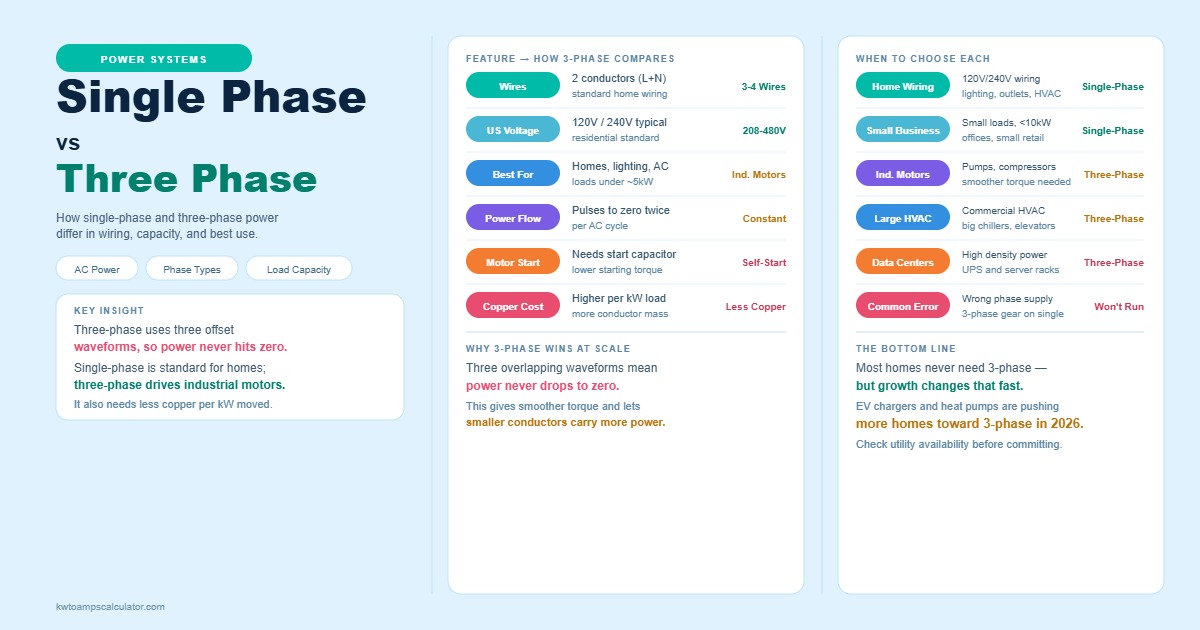
Table of Contents
- What Is the Difference Between Single Phase and Three Phase Power?
- Single Phase vs Three Phase Power: 7 Key Differences at a Glance
- Which Properties Need Single Phase Power?
- Which Properties Need Three Phase Power?
- How to Determine Which Power Type Your Property Needs
- Is Three Phase Power Available in Residential Areas?
- How Much Does Three Phase Power Installation Cost Compared to Single Phase?
- Can You Convert Single Phase Power to Three Phase Power?
- Single Phase vs Three Phase Power: Which Offers Better Efficiency?
- Frequently Asked Questions About Single Phase vs Three Phase Power
- Conclusion: Choose the Right Power System for Your Property
Single phase power suits residential properties and small businesses with light electrical demand. Three phase power suits factories, hospitals, and data centers that run heavy equipment continuously. The choice between single phase vs three phase power depends on your total load, the size of your motors, and your local utility infrastructure. You avoid costly upgrades later when you match the correct system to your property now. This guide compares single phase vs three phase power in full, breaks down real installation costs, and helps you pick the correct type for your property in 2026.
What Is the Difference Between Single Phase and Three Phase Power?
The core difference between single phase vs three phase power lies in the number of alternating current (AC) waveforms delivered to your property. Single phase power carries one waveform through 2 wires. Three phase power carries 3 separate waveforms through 3 or 4 wires, each offset by 120 degrees. Engineers choose between a Star configuration and a Delta configuration when they wire three phase equipment, since each configuration changes the available voltage and the neutral wire requirement.
Single phase power drops to zero voltage twice every cycle, creating a pulsing delivery of energy. Three phase power never drops to zero because the 3 waveforms overlap. This overlap gives three phase systems a steadier power supply for heavy equipment such as motors, compressors, and industrial pumps.
How Single Phase Power Delivers Electricity
To deliver single phase power, your utility sends current through one hot wire and one neutral wire. The voltage rises and falls in a single sine wave, reaching 120 volts in North America and 230 volts across most of Europe. Single phase circuits power lighting, refrigerators, and small kitchen appliances such as microwaves, toasters, and coffee makers. These circuits also support larger 240-volt loads, including electric dryers and air conditioners, by combining 2 hot wires. This wiring forms one half of the single phase vs three phase power comparison.
How Three Phase Power Delivers Electricity
To deliver three phase power, your utility sends current through 3 hot wires plus 1 neutral wire in most configurations. Each wire carries a waveform offset by 120 degrees from the other two. This offset keeps at least one wire near peak voltage at all times, which removes the power gaps found in single phase systems. Three phase power reaches 400 volts in Europe and 480 volts in North American industrial settings.
Single Phase vs Three Phase Power: 7 Key Differences at a Glance
This single phase vs three phase power table below saves you a call to your electrician. Convert your appliance list into amps first using a kVA to amps calculator, so you compare single phase vs three phase power using real numbers instead of guesswork.
|
Feature |
Single Phase |
Three Phase |
Install Difficulty |
|
Wire count |
2 wires |
3 to 4 wires |
Moderate |
|
Typical US voltage |
120V / 240V |
208V / 480V |
High for 3-phase |
|
Typical EU voltage |
230V |
400V |
High for 3-phase |
|
Best for |
Homes, small shops |
Factories, data centers |
N/A |
|
Power delivery |
Drops to zero twice per cycle |
Never drops to zero |
N/A |
|
Install cost (avg.) |
$1,500-$4,000 |
$8,000-$25,000 |
High for 3-phase |
|
Motor efficiency |
80%-85% |
Up to 97% |
N/A |
Single phase installation costs 30% to 50% less than three phase installation in most regions. Three phase power delivers up to 1.73 times more power per conductor than single phase power at the same current. This ratio comes from the square root of 3 (approximately 1.732), the constant used in every three phase load calculation. Electricians and engineers apply this same constant when they size transformers, cables, and circuit breakers for industrial panels.
Which Properties Need Single Phase Power?
The single phase vs three phase power decision starts with your total load. Single phase power meets the needs of most homes, apartments, and small commercial spaces. Properties with a total electrical load under 100 amps typically run well on single phase power. Single phase properties include single-family houses, duplexes, small offices, and retail shops that use standard lighting and small appliances.
Homes and Small Apartments
Homes and small apartments draw single phase power for lighting circuits, kitchen appliances such as refrigerators, ovens, and dishwashers, and HVAC units under 5 tons. A typical house uses a 100-amp or 200-amp single phase panel, sized 10 inches (25cm) to 20 inches (51cm) wide. This capacity covers most residential circuits without upgrades. Homeowners rarely need to weigh single phase vs three phase power beyond this point.
Small Offices and Retail Shops
Small offices and retail shops such as bakeries, salons, and boutique stores also run on single phase power. These properties draw lighter loads from computers, point-of-sale systems, and standard lighting fixtures. A single phase 200-amp service supports most small commercial spaces up to 3,000 square feet (279 square meters). This single phase vs three phase power distinction rarely changes for shops under this size.
Small Farms and Home Workshops
Small farms and home workshops with equipment under 5 horsepower also run well on single phase power. Grain augers, small water pumps, and woodworking tools such as table saws, planers, and drill presses draw well within single phase capacity. Owners who plan to add larger irrigation pumps or grain dryers later should ask their utility about three phase availability before they install a single phase panel. A single phase 100-amp subpanel usually handles a hobby workshop of 400 square feet (37 square meters) or smaller without strain. The single phase vs three phase power line sits close to 5 horsepower for most small equipment.
Which Properties Need Three Phase Power?
On the other side of the single phase vs three phase power comparison sit properties with heavy machinery, large motors, or continuous high loads. Properties with equipment drawing over 100 amps at 3 or more horsepower typically require three phase power.
Factories and Manufacturing Plants
Factories and manufacturing plants such as textile mills, metal fabrication shops, and food processing facilities run three phase power for conveyor belts, industrial pumps, and large compressors. These motors need the constant torque that three phase power provides. A single phase motor of the same size draws far more current and overheats faster. This gap explains why the single phase vs three phase power choice matters most for heavy industrial equipment.
Data Centers and Server Rooms
Data centers and server rooms draw three phase power to run servers, cooling systems, and uninterruptible power supply (UPS) units around the clock. Three phase power reduces voltage fluctuation risk for sensitive computing equipment. Server racks pull steady current 24 hours a day, and three phase delivery prevents the power dips that stress hardware. IT managers rarely revisit the single phase vs three phase power decision once a facility scales past a few racks.
Large Commercial Buildings
Large commercial buildings such as hospitals, shopping malls, and office towers over 10,000 square feet (929 square meters) typically install three phase power. Elevators, large HVAC chillers, and commercial kitchen equipment all draw heavy, motor-driven loads that single phase circuits cannot support efficiently. Building codes in most US cities require three phase service once a building exceeds a set occupancy or square footage threshold, so architects plan the electrical room around this requirement from the design stage. The single phase vs three phase power question rarely stays open past the design stage for buildings this size.
Agricultural and Irrigation Operations
Large farms with center-pivot irrigation systems, grain dryers, and dairy milking equipment also require three phase power. A single center-pivot irrigation motor draws 20 to 75 horsepower, a load that single phase service cannot handle without a phase converter. Dairy operations running multiple vacuum pumps and milk chillers at once benefit from the steady torque that three phase power provides. Farm equipment dealers can usually confirm the single phase vs three phase power requirement for any motor before you buy it.
How to Determine Which Power Type Your Property Needs
To determine your single phase vs three phase power needs, add up the total amperage draw of every major appliance and motor. Use a three-phase power calculator to convert your total kilowatt (kW) load into amps for accurate sizing. Check your largest single motor rating next, since any motor over 5 horsepower runs more efficiently on three phase power. Contact your local utility company to confirm three phase availability at your address, because not every street carries a three phase line. Ask a licensed electrician to inspect your panel and confirm your service type through the meter and distribution board. Compare your final total against the 100-amp threshold used throughout this guide, then choose single phase power for lighter loads or three phase power for anything heavier.
Is Three Phase Power Available in Residential Areas?
Your single phase vs three phase power outcome often depends on street infrastructure before cost even enters the conversation. Yes, three phase service is available in many residential areas, though your exact street decides the answer. Older residential neighborhoods in the US often carry only single phase lines, while newer developments and mixed-use districts frequently run three phase distribution alongside single phase service. UK and most European streets already carry three phase distribution, so homeowners there typically pay less to add a three phase connection than US homeowners do. Rural properties face the widest range of outcomes, since some rural cooperatives run three phase lines along main roads while side roads carry single phase only.
Call your utility company directly and give them your address before you budget for equipment. A utility representative checks the nearest transformer and distribution line, then tells you whether three phase service reaches your property or requires a new line extension.
How Much Does Three Phase Power Installation Cost Compared to Single Phase?
Cost separates single phase vs three phase power more than any other factor covered so far. Three phase power installation costs 2 to 4 times more than single phase installation in most regions. Single phase panel upgrades cost $1,500 to $4,000 (£1,200 to £3,200) in the US and UK. Three phase installation costs $8,000 to $25,000 (£6,500 to £20,000) depending on distance from the utility transformer. Properties located over 500 feet (152 meters) from a three phase line pay the highest connection fees because the utility must extend new conductors to reach the property.
Permit fees, trenching, and transformer sizing all add to the final invoice. A licensed electrician typically charges $2,000 to $6,000 (£1,600 to £4,800) in labor alone for a three phase panel swap, separate from the utility connection fee. Ask for 3 written quotes before you sign a contract, since prices vary widely between contractors in the same city.
Every three phase installation in the US must meet National Electrical Code (NEC) Article 230 requirements for service entrance conductors and grounding. Your local permit office inspects the finished panel before your utility activates the new service. Skipping this inspection step risks fines and delays your connection date by several weeks.
Can You Convert Single Phase Power to Three Phase Power?
Yes, you can convert single phase power to three phase power using 2 main methods: a phase converter or a utility service upgrade. This single phase vs three phase power question comes up often among workshop owners who outgrow their existing service.
Phase Converters
A phase converter creates a third simulated phase from your existing single phase supply. Rotary converters, static converters, and variable frequency drives (VFDs) all perform this task at different price points and efficiency levels. Rotary converters cost $1,000 to $5,000 (£800 to £4,000) and support motors up to 100 horsepower. This option bridges the single phase vs three phase power gap without a full utility upgrade.
Utility Upgrades
A utility upgrade brings a genuine three phase line directly to your property from the grid. This method costs more than a phase converter but delivers full three phase power without simulated waveforms. Request a service upgrade quote from your utility company before you commit to new industrial equipment.
Single Phase vs Three Phase Power: Which Offers Better Efficiency?
The single phase vs three phase power efficiency gap grows wider as your load increases. Three phase power offers better efficiency than single phase power for loads over 10 kW. Three phase motors convert up to 97% of electrical energy into mechanical output, while single phase motors typically reach 80% to 85% efficiency at the same load. Three phase systems also transmit power using less conductor material, which lowers transmission losses over long distances such as 1,000 feet (305 meters) or more. Facility managers running motors 8 or more hours a day recover the higher three phase installation cost through lower energy bills within 3 to 5 years.
Frequently Asked Questions About Single Phase vs Three Phase Power
Is Three Phase Power Better Than Single Phase Power?
Yes. Three phase power delivers steadier current and higher efficiency for heavy equipment, though single phase power costs less to install for homes and small shops. Your property size and equipment list decide the better fit in the single phase vs three phase power comparison, not a fixed rule.
Can a House Run on Three Phase Power?
Yes. Larger homes with electric vehicle chargers, workshops, or backup generators over 15 kW often install three phase power for added capacity. Standard smaller homes rarely need to weigh single phase vs three phase power beyond their base panel size.
How Many Wires Does Three Phase Power Use?
Three phase power uses 3 hot wires plus 1 neutral wire in most four-wire configurations, or 3 wires alone in a three-wire delta setup. The wire count also affects conduit size, so electricians plan trench and conduit width around this number early.
Does Three Phase Power Cost More Per Kilowatt-Hour?
No. Utility rates per kilowatt-hour (kWh) stay the same across single phase vs three phase power. Only the installation and equipment costs differ between single phase and three phase power. Commercial customers on three phase service sometimes pay separate demand charges based on peak kW draw.
Can I Convert My Home From Single Phase to Three Phase Power?
Yes. You can install a phase converter or request a utility upgrade, though converters suit smaller loads and upgrades suit permanent three phase needs. Compare both options against your budget and your long-term equipment plans before you decide.
Conclusion: Choose the Right Power System for Your Property
The single phase vs three phase power decision comes down to your load, your budget, and your utility's infrastructure. Single phase power fits most homes and small businesses with light electrical loads. Three phase power fits factories, data centers, and large commercial buildings that run heavy motors continuously. Calculate your exact load and read the kW vs kVA guide on kwtoampscalculator.com before you contact an electrician or your utility company. Sizing your service correctly the first time saves you thousands of dollars in avoided upgrades.
About Usman Haider
We are dedicated to providing accurate, easy-to-understand information. Our goal is to help you minimize effort and maximize results.