Voltage Drop Calculator 2026: Wire Length & Amp Safety Tips
Use our voltage drop calculator to check wire length, amperage, and NEC limits for 2026. Get accurate results and size wire safely today.
Usman Haider
Contributor
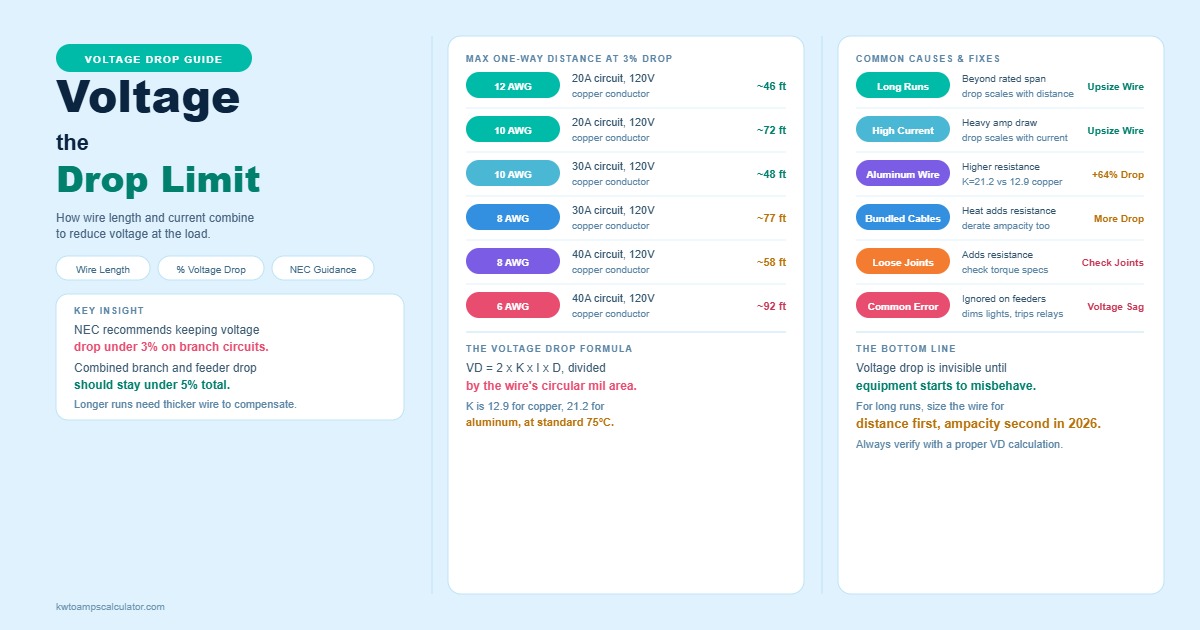
Table of Contents
- What Does a Voltage Drop Calculator Measure?
- How Does Wire Length Increase Voltage Drop?
- What Is the Voltage Drop Formula?
- What Voltage Drop Percentage Is Safe Under NEC Rules?
- How Does Wire Gauge Affect Voltage Drop and Amperage?
- What Are 5 Warning Signs of Excessive Voltage Drop?
- How to Reduce Voltage Drop on Long Wire Runs
- Voltage Drop Troubleshooting Tasks at a Glance
- Frequently Asked Questions
- Size Your Wire Correctly Before You Buy
A voltage drop calculator measures the electrical potential a wire loses between the source and the load. Enter the wire gauge, current in amps, one-way distance, and conductor material, and the tool returns the voltage lost, the percentage drop, and the voltage remaining at the load.
Wire length and current both drive this loss. A 100-foot (30-meter) run carries a bigger drop than a 20-foot (6-meter) run at the same amperage. Left unchecked, voltage drop dims lights, overheats motors, and trips breakers without warning.
This guide explains the formula behind a voltage drop calculator, the safe percentage limits set by the National Electrical Code (NEC), and 5 ways to size wire correctly for long runs. You get worked examples in both imperial and metric units, so you can apply a voltage drop calculator to any project in the US, UK, Canada, or elsewhere.
Most online tools skip 2 details that change real-world accuracy: ambient temperature correction and startup inrush current on motor loads. This guide covers both, since a voltage drop calculator that ignores them can understate the true drop by 10% or more on hot job sites or motor-heavy circuits.
What Does a Voltage Drop Calculator Measure?
A voltage drop calculator measures 3 outputs: voltage lost in the wire, the percentage of source voltage lost, and the voltage available at the load. You supply 4 inputs: conductor material, wire gauge, one-way distance, and load current in amps.
Copper and aluminum are the two conductor materials most calculators list. Copper carries a resistance of 12.9 ohms per circular mil-foot, while aluminum carries 21.2 ohms per circular mil-foot. This resistance value, combined with wire length and gauge, produces the final voltage drop figure that a voltage drop calculator displays.
Electricians, engineers, and DIY homeowners use a voltage drop calculator before running any circuit longer than 50 feet (15 meters). The tool prevents undersized wire from reaching the panel, the workshop, or the pool pump. A contractor in Toronto sizing a detached garage feeder and a homeowner in Manchester wiring a garden shed both rely on the same core formula, even though local code names differ.
Manual calculation takes 5 to 10 minutes per circuit, while a voltage drop calculator returns the same result in under 1 second. Speed matters on job sites with 20 or more circuits to check before final inspection.
How Does Wire Length Increase Voltage Drop?
Wire length increases voltage drop because resistance rises with every added foot or meter of conductor. Current pushes through more material, and that resistance converts part of the electrical energy into heat instead of usable power at the load.
Consider two 12 AWG copper circuits carrying 20 amps at 120 volts. A 50-foot (15-meter) run drops around 2.4 volts, a 2% drop. A 150-foot (46-meter) run on the same wire drops around 7.1 volts, close to 6%, which exceeds the recommended limit. Run both scenarios through a voltage drop calculator and the gap becomes obvious within seconds.
Distance multiplies the effect of current and resistance together. Doubling the wire length doubles the voltage drop at a constant amperage and gauge. Tripling the length triples it under the same conditions.
Three scenarios commonly trigger long-run voltage drop problems: detached garages, well pumps, and dock or shed wiring. Each often sits 100 feet (30 meters) or more from the main panel. A voltage drop calculator becomes essential once a run passes that 100-foot (30-meter) mark, since guesswork at that distance risks undersized conductors.
Temperature also plays a secondary role. Conductor resistance rises slightly as ambient temperature climbs, so a voltage drop calculator that accounts for 75 degree Celsius or 90 degree Celsius insulation ratings gives a more accurate figure than a simple length-only estimate.
What Is the Voltage Drop Formula?
The voltage drop formula multiplies current by total conductor resistance. For single-phase circuits, the formula reads: VD equals 2 times K times I times D, divided by CM, where K is the resistance constant, I is current in amps, D is one-way distance in feet, and CM is the circular mil area of the wire. A voltage drop calculator automates this equation so you avoid manual circular mil lookups.
How to Calculate Single-Phase Voltage Drop
To calculate single-phase voltage drop, multiply 2 by the resistance constant, the current in amps, and the one-way distance in feet, then divide by the wire's circular mil area. For a 10 AWG copper wire with 10,380 circular mils carrying 15 amps over 75 feet (23 meters), the formula returns a drop of 2.79 volts, or 2.3% of a 120-volt supply. A voltage drop calculator performs this same math in under 1 second and displays the remaining voltage at the load automatically.
How to Calculate Three-Phase Voltage Drop
To calculate three-phase voltage drop, multiply the square root of 3, which equals 1.732, by the resistance constant, current, and one-way distance, then divide by the circular mil area. Three-phase systems balance current across 3 conductors, so the formula produces a lower percentage drop than a single-phase circuit carrying the same load. A voltage drop calculator built for industrial use switches between single-phase and three-phase modes automatically once you select the system type.
What Voltage Drop Percentage Is Safe Under NEC Rules?
The National Electrical Code recommends a maximum voltage drop of 3% for branch circuits and 5% total for the combined feeder and branch circuit. A 240-volt circuit should lose no more than 7.2 volts under the 3% branch limit. A voltage drop calculator flags any result above these thresholds instantly, saving you a manual percentage check.
The NEC does not classify voltage drop as a direct safety violation on residential branch circuits, but exceeding 5% causes 3 measurable problems: motor overheating, reduced light output, and appliance malfunction. Inspectors in Canada, the UK, and the US commonly reference these same percentage limits during commercial plan review. Review the NEC breaker sizing rules to confirm your breaker matches the corrected ampacity after you account for voltage drop.
Sensitive electronics, medical equipment, and HVAC compressors need tighter margins. Keep drop under 2% for these loads to avoid nuisance faults and shortened equipment life. Run these specialized circuits through a voltage drop calculator twice, once at full load and once at startup inrush current, since inrush current on compressors can reach 6 to 8 times the running amperage.
How Does Wire Gauge Affect Voltage Drop and Amperage?
Wire gauge affects voltage drop because thicker conductors carry lower resistance per foot. A 10 AWG wire drops less voltage than a 14 AWG wire over the same 100-foot (30-meter) distance at identical amperage. A voltage drop calculator lets you compare 3 or 4 gauge options side by side before you commit to a purchase.
Copper Wire vs Aluminum Wire Performance
Copper wire outperforms aluminum wire in voltage drop because copper carries roughly 40% less resistance for the same gauge. Aluminum conductors need 1 to 2 gauge sizes larger than copper to match the same voltage drop and ampacity rating. Most residential branch circuits in the US, UK, and Canada use copper, while some large feeders use aluminum for cost savings. Enter both materials into a voltage drop calculator to compare the total cost against the performance difference for your specific run.
Aluminum also expands and contracts more than copper as temperature changes, which loosens terminal connections over years of service. This expansion problem, not the resistance value alone, drives most electricians toward copper for branch circuits under 60 amps. Large commercial feeders above 200 amps often switch to aluminum, since the weight savings on long overhead or underground runs outweigh the extra gauge size needed.
AWG Sizes and Their Voltage Drop Impact
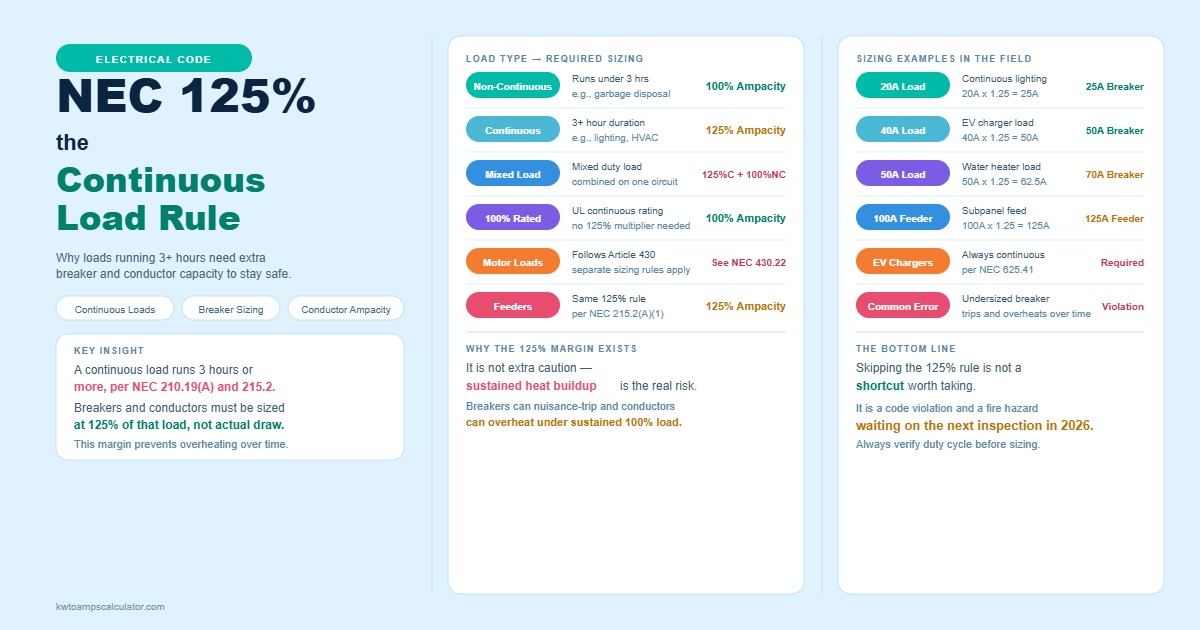
American Wire Gauge (AWG) sizing runs in reverse order, since smaller numbers mean thicker wire. Three common residential gauges illustrate the pattern: 14 AWG handles 15 amps, 12 AWG handles 20 amps, and 10 AWG handles 30 amps, each at standard 90 degree Celsius insulation ratings before derating. Moving from 14 AWG to 12 AWG cuts voltage drop by roughly 37% over the same distance. Confirm your load first with the kW to amps calculator, then match that amperage to the correct gauge inside a voltage drop calculator before you buy wire.
What Are 5 Warning Signs of Excessive Voltage Drop?
Excessive voltage drop produces 5 recognizable symptoms: flickering or dim lights, motors that run hot, appliances that hum or struggle to start, breakers that trip under normal load, and visibly warm outlets or switches.
Flickering lights often appear first because incandescent and LED fixtures are sensitive to even a 3% to 5% voltage reduction. Motors respond next, drawing higher current to compensate for lost voltage, which raises heat inside the windings and shortens motor life by hundreds of operating hours.
A warm outlet or switch plate signals resistance heating somewhere in the circuit. Shut off the circuit and inspect the wire gauge and connections immediately if you notice this symptom. Run the circuit's amperage and distance through a voltage drop calculator to confirm whether the wire size caused the problem.
Appliances that hum, buzz, or restart repeatedly often point to a voltage drop above 5% at the load. Refrigerators, well pumps, and air conditioners show this symptom most often because their compressors need stable startup voltage.
Nuisance breaker trips form the fifth symptom, and electricians often misdiagnose these as a faulty breaker. The real cause is frequently a long, undersized run where the added resistance pushes current higher than the breaker rating allows. Testing the run through a voltage drop calculator before replacing any breaker saves both time and money.
How to Reduce Voltage Drop on Long Wire Runs
To reduce voltage drop on long wire runs, increase the wire gauge, shorten the physical run where possible, and split heavy loads across 2 or more circuits. Each method lowers the resistance the current must overcome, and a voltage drop calculator confirms which method produces the biggest improvement for your specific circuit.
Upsizing the wire gauge remains the most common fix. Moving a 100-foot (30-meter) 20-amp circuit from 12 AWG to 10 AWG typically cuts the percentage drop by close to one-third. Test the new gauge in a voltage drop calculator before you purchase the full spool of wire.
A straighter conduit path also shortens distance. A run that avoids unnecessary turns through walls or ceilings can save 10 to 20 feet (3 to 6 meters) compared to a winding path. Splitting a heavy 40-amp workshop load into 2 separate 20-amp circuits reduces the current on each conductor, which lowers voltage drop on both runs simultaneously.
Cost rises with wire gauge, so weigh the extra material cost against the benefit before you upsize. A 10 AWG copper spool typically costs 60% more per foot than 12 AWG, but the added expense on a 150-foot (46-meter) run remains small next to the cost of a burned-out motor or a failed inspection.
When to Upsize Your Wire Gauge
Upsize your wire gauge whenever a calculated drop exceeds 3% for a branch circuit or whenever the run exceeds 100 feet (30 meters) at full rated amperage. Run the confirmed amperage through a voltage drop calculator immediately to verify the exact wire size needed for your distance and load.
Voltage Drop Troubleshooting Tasks at a Glance
The table below summarizes 5 common voltage drop tasks, along with timing, method, and difficulty, so you can plan the work before you open a voltage drop calculator.
|
Task |
Timing |
Method |
Difficulty |
|
Check drop on a new branch circuit |
Before wiring |
Voltage drop calculator |
Easy |
|
Upsize wire gauge for a long run |
During rough-in |
Manual gauge comparison |
Easy |
|
Diagnose flickering lights |
After installation |
Load test plus calculator |
Moderate |
|
Correct for ambient temperature |
Hot climate jobs |
Temperature-adjusted formula |
Moderate |
|
Verify three-phase feeder sizing |
Commercial projects |
Three-phase formula |
Advanced |
Frequently Asked Questions
Does voltage drop affect amperage?
Yes. Voltage drop raises current draw at a fixed power level, since current equals power divided by voltage, so a lower voltage produces higher amperage for the same load. A voltage drop calculator shows this relationship directly in its results.
What is an acceptable voltage drop percentage?
3% for branch circuits and 5% total for combined feeder and branch circuits, per NEC guidance. A voltage drop calculator applies these same limits automatically when it flags a result as unsafe.
Does wire length matter more than wire gauge?
No. Wire gauge and length both influence voltage drop directly, and neither factor works alone. Doubling either one roughly doubles the drop at a constant amperage, which is why a voltage drop calculator asks for both values before returning a result.
Can I use a voltage drop calculator for DC circuits?
Yes. DC circuits use the same core formula without the reactance component that AC three-phase calculations include, so a voltage drop calculator handles both circuit types accurately.
How far can 12 AWG wire run without excessive drop?
12 AWG copper wire carrying 20 amps at 120 volts can run roughly 65 feet (20 meters) one-way before reaching a 3% drop. Longer runs need 10 AWG wire or larger, which you can confirm with a voltage drop calculator in seconds.
Size Your Wire Correctly Before You Buy
Wire length, gauge, and current together determine how much voltage a circuit loses before it reaches the load. Confirm your system type with our single vs three-phase guide before you finalize wire gauge, then run the numbers through a voltage drop calculator for the exact percentage drop on your circuit in 2026.

About Usman Haider
We are dedicated to providing accurate, easy-to-understand information. Our goal is to help you minimize effort and maximize results.