What Size Solar Inverter Do You Need? A 2026 Sizing Guide
Find the exact size solar inverter your system needs in 2026. Use our free calculator and sizing charts to cut clipping losses today.
Usman Haider
Contributor
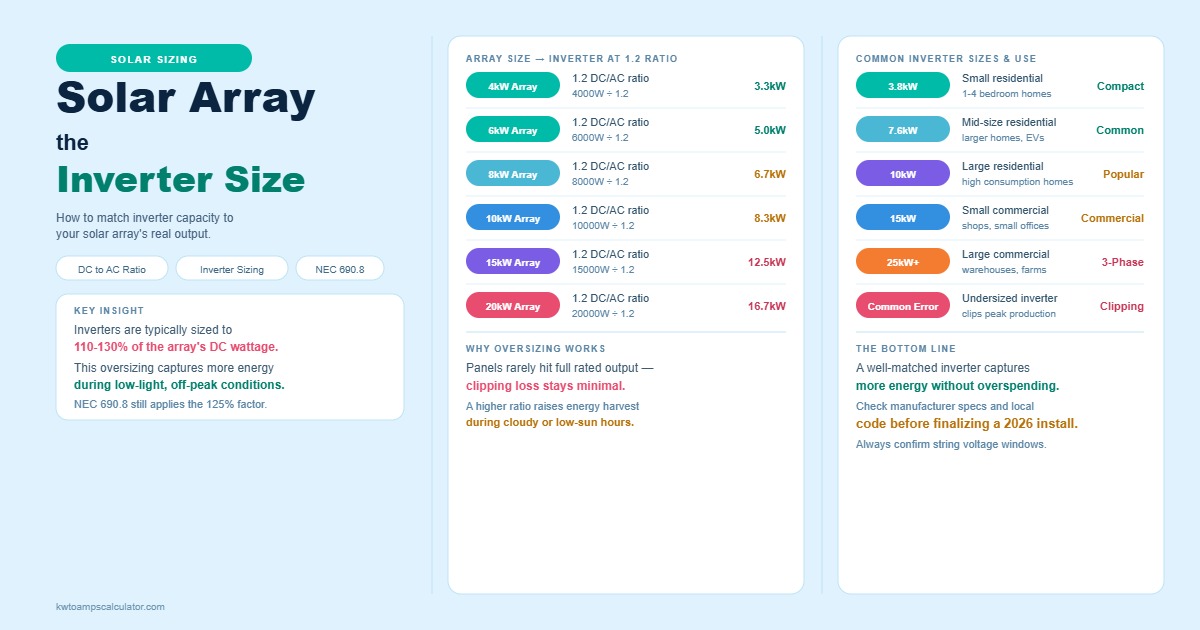
Table of Contents
- What Size Solar Inverter Do You Need for Your System?
- How to Calculate Solar Inverter Size by System Wattage
- What Size Inverter Do You Need for Common System Sizes?
- What Inverter Size Do Grid-Tie, Off-Grid, and Hybrid Systems Need?
- How to Size an Off-Grid Solar Inverter for Appliance Loads
- What Is the Difference Between String Inverters, Microinverters, and Hybrid Inverters?
- How Does Inverter Clipping Affect Your Sizing Decision?
- How Do Geography and Site Conditions Change Inverter Sizing?
- What Size Inverter Do You Need for a Home Battery Backup System?
- How Much Does Solar Inverter Size Affect Installation Cost?
- Quick-Reference: Solar Inverter Sizing Tasks
- Frequently Asked Questions
- Final Word on Solar Inverter Size
Your solar inverter size should match 80% to 120% of your solar array's total DC wattage. A 6-kilowatt (kW) solar array typically pairs with a 5,000W to 7,200W inverter, depending on your chosen DC-to-AC ratio and site conditions.
Getting the solar inverter size wrong causes 2 problems. An undersized inverter clips excess power and wastes energy production. An oversized inverter runs below its own capacity and adds upfront cost without adding output. This guide gives you exact inverter sizes for common system sizes, off-grid load calculations, and the ratio formulas installers use in 2026.
Selecting the correct solar inverter size also protects your equipment warranty and your long-term energy output. Manufacturers publish exact sizing windows for each product line, and installers who ignore those windows risk having warranty claims denied. The sections below walk through every scenario you need: grid-tie arrays, off-grid battery banks, and hybrid systems that combine both.
What Size Solar Inverter Do You Need for Your System?
Solar inverter size depends on 3 factors: your solar array wattage, your geographic location, and your site conditions. Array wattage carries the most weight in the calculation, since your inverter converts every watt the array produces.
Your inverter's AC output rating should sit close to your array's direct current (DC) rating.
Manufacturers such as SMA Solar, SolarEdge, and Fronius publish a maximum DC input figure on every inverter spec sheet. Exceeding that figure voids your equipment warranty.
Properties with high solar irradiance, such as sites in Arizona and Nevada, operate inverters at a closer 1:1 ratio because panels reach peak output more often. Properties with lower irradiance or higher temperatures, such as sites in Washington and Michigan, tolerate a smaller inverter relative to array size because panels rarely hit their rated maximum output.
How to Calculate Solar Inverter Size by System Wattage
To calculate solar inverter size by system wattage, divide your total panel wattage by your target DC-to-AC ratio. A 7,000W array with a 1.2 ratio needs a 5,833W inverter, rounded up to the nearest available model size.
How to Apply the DC to AC Ratio Formula
To apply the DC-to-AC ratio formula, divide your array's DC wattage by your inverter's maximum alternating current (AC) output. Most residential systems across the US, UK, and Canada use a ratio between 1.15 and 1.25. Ratios above 1.55 trigger heavy clipping losses on sunny days, based on manufacturer guidelines published by inverter brands including SolarEdge and SMA Solar.
How to Read a Manufacturer Spec Sheet for Sizing
To read a manufacturer spec sheet for sizing, locate 3 numbers: maximum DC input in watts, maximum AC output in watts, and maximum input voltage. Match your string wattage and voltage to these 3 limits before you finalize your inverter selection. Never exceed the maximum input voltage figure, since doing so risks permanent damage to your inverter.
Check the minimum start-up voltage figure as well, especially for installations in cold climates such as Canada and Northern England. Panel voltage rises in cold weather, and a string sized for a warm climate can exceed your inverter's maximum input voltage on a frosty morning.
What Size Inverter Do You Need for Common System Sizes?
The table below shows recommended inverter sizes for 5 common solar array sizes, calculated at a standard 1.2 DC-to-AC ratio.
|
System Size |
Array Wattage |
DC-to-AC Ratio |
Recommended Inverter Size |
|
3kW |
3,000W |
1.2 |
2,500W |
|
5kW |
5,000W |
1.2 |
4,200W |
|
6kW |
6,000W |
1.2 |
5,000W |
|
8kW |
8,000W |
1.2 |
6,800W |
|
10kW |
10,000W |
1.2 |
8,500W |
A 3kW system, or 3,000W, needs a 2,500W inverter. A 5kW system, or 5,000W, needs a 4,200W inverter after rounding to the nearest available model. An 8kW system, or 8,000W, needs a 6,800W inverter, and a 10kW system, or 10,000W, needs an 8,500W inverter.
Run your own array wattage against multiple ratio targets using the solar inverter size calculator at kwtoampscalculator.com. The tool returns an exact inverter range in seconds instead of a rough estimate.
What Inverter Size Do Grid-Tie, Off-Grid, and Hybrid Systems Need?
Grid-tie, off-grid, and hybrid systems need different inverter sizing methods because each system sends power to a different destination. A grid-tie inverter sizes against your array wattage alone, since the utility grid absorbs any excess. An off-grid inverter sizes against your household appliance loads, since no grid connection exists to absorb a shortfall. A hybrid inverter sizes against both figures at once, plus your battery charge and discharge rate.
Grid-tie solar inverter size follows the DC-to-AC ratio method covered above, typically landing between 80% and 125% of array wattage. Off-grid solar inverter size follows the appliance load method, typically landing between 3,000W and 7,000W for a full household. Hybrid systems need the larger of the 2 figures, plus 20% headroom for simultaneous solar charging and appliance draw.
How to Size an Off-Grid Solar Inverter for Appliance Loads
To size an off-grid solar inverter for appliance loads, add up the continuous wattage of every device you plan to run at once, then multiply the total by 1.25 for a safety margin.
How to Calculate Continuous Load Watts
To calculate continuous load watts, list every appliance you plan to run simultaneously, such as a refrigerator (150W), 3 LED lights (30W total), and a laptop (60W). Adding these 3 loads gives you 240W of continuous demand before you apply your safety margin.
How to Add Surge Power for Motor-Driven Appliances
To add surge power for motor-driven appliances, check the starting wattage listed on the nameplate of devices such as refrigerators, well pumps, and window air conditioners. A refrigerator rated at 150W running often draws 450W to 600W at startup. Your inverter's peak or surge rating must exceed your highest single surge figure plus your other running loads combined.
Off-grid and hybrid systems also need a battery bank sized to match inverter draw. The solar battery size calculator at kwtoampscalculator.com calculates the amp-hour (Ah) capacity your battery bank needs to support your chosen inverter for a set number of hours.
What Is the Difference Between String Inverters, Microinverters, and Hybrid Inverters?
String inverters, microinverters, and hybrid inverters size differently because each device handles DC-to-AC conversion at a different point in your system.
When to Choose a String Inverter
Choose a string inverter when your roof has 1 or 2 unshaded planes facing the same direction. Size a string inverter at 80% to 110% of your total panel wattage, since 1 unit handles the entire array at once.
When to Choose Microinverters
Choose microinverters when your roof has multiple sections, chimneys, or partial shading throughout the day. Size each microinverter to match a single panel's output, typically 250W to 400W per unit, because microinverters optimize panels individually rather than as a group.
When to Choose a Hybrid Inverter
Choose a hybrid inverter when your system pairs solar panels with battery storage on the same circuit. Size a hybrid inverter using both your array wattage and your planned battery discharge rate, since the unit manages solar charging, battery storage, and AC output together.
How Does Inverter Clipping Affect Your Sizing Decision?
Inverter clipping occurs when your solar array produces more DC power than your inverter can convert to AC at a given moment. Clipping caps your output at the inverter's maximum AC rating, even if the array generates more power than that figure.
A 7,000W array paired with a 5,000W inverter clips any output above 5,000W during peak sun hours. Installers accept minor clipping because panels rarely hit their full rated wattage under real-world temperature and angle conditions. Keep your DC-to-AC ratio under 1.35 to limit clipping losses to under 3% of annual production.
Clipping happens most often at midday in summer, when panel temperature is lowest relative to irradiance and output peaks. A correctly sized inverter absorbs this brief peak without cutting your annual production by a meaningful margin. An inverter sized below an 80% ratio, however, clips power across most sunny afternoons and reduces your yearly output noticeably.
How Do Geography and Site Conditions Change Inverter Sizing?
Geography changes inverter sizing because solar irradiance varies by region. Properties in Texas and California produce closer to their rated maximum than properties in Oregon or Scotland, so installers in high-irradiance regions choose a lower DC-to-AC ratio.
Site conditions such as roof tilt, azimuth, shading, and dust add a derating factor to your system. A derating factor of 15% means your array rarely reaches its full DC rating, which lets you safely pair it with a smaller inverter relative to panel wattage.
Track your production after installation and compare it against your inverter's rated capacity. A gap larger than 20% between expected and actual output signals a sizing or shading problem worth a professional inspection.
Altitude affects sizing too, since thinner air at high elevation increases solar irradiance intensity. Installers in mountain regions such as Colorado and the Scottish Highlands often size inverters closer to a 1:1 ratio to capture the extra output these sites produce.
What Size Inverter Do You Need for a Home Battery Backup System?
A home battery backup inverter needs enough continuous wattage to run your essential circuits, plus enough surge capacity for your highest-draw appliance. Most homes need a 3,000W to 5,000W inverter to run lights, a refrigerator, and a well pump or microwave together.
Confirm your charge controller and inverter share compatible voltage and amperage ratings before installation. The charge controller calculator at kwtoampscalculator.com matches pulse width modulation (PWM) and maximum power point tracking (MPPT) controller ratings to your chosen inverter and battery voltage.
Add 20% to 30% headroom to your battery backup inverter size if you plan future appliance additions, such as an electric vehicle (EV) charger or a second refrigerator. Buying a slightly larger inverter now costs less than replacing an undersized unit later.
List your 3 highest-priority circuits before you size a backup inverter: refrigeration, medical equipment, and lighting rank first for most households. Sizing around these priority circuits first prevents you from overspending on whole-home capacity you rarely need during a short outage.
How Much Does Solar Inverter Size Affect Installation Cost?
Solar inverter size affects installation cost directly, since manufacturers price units by their maximum AC output capacity. A 5,000W string inverter typically costs $1,000 to $1,500 (£800 to £1,200), while an 8,000W unit typically costs $1,800 to $2,600 (£1,450 to £2,100).
Oversizing your inverter by even 1 model tier adds cost without adding energy production, since your array wattage still sets your output ceiling. Undersizing your inverter to save money creates ongoing clipping losses that cost you more in lost production over a 10-year to 25-year system lifespan than the initial price difference.
Compare 3 inverter brands, such as SMA Solar, SolarEdge, and Fronius, before you finalize your purchase. Warranty length, monitoring features, and MPPT input count vary between brands at the same wattage tier, and these differences affect long-term value more than sticker price alone.
Quick-Reference: Solar Inverter Sizing Tasks
|
Task |
Timing |
Method |
Difficulty |
|
Calculate array wattage |
Before purchase |
Add panel wattage x panel count |
Easy |
|
Apply DC-to-AC ratio |
Before purchase |
Divide array watts by target ratio |
Easy |
|
List appliance loads |
Off-grid systems only |
Sum continuous watts per device |
Moderate |
|
Add surge margin |
Off-grid and hybrid systems |
Add highest motor surge watts |
Moderate |
|
Check spec sheet limits |
Before purchase |
Compare DC input and voltage limits |
Easy |
|
Review production data |
3 months after install |
Compare actual vs rated output |
Moderate |
Frequently Asked Questions
Can my inverter be bigger than my solar panels?
Yes, an inverter can exceed your array wattage, though running it above a 1:1 ratio wastes capacity and raises upfront cost without adding output. Most installers cap this ratio at 1.0 to 1.1 to avoid paying for unused inverter headroom.
Does a bigger inverter produce more power?
No, inverter size does not increase power production. Your solar array wattage sets your maximum output regardless of inverter capacity, so a larger inverter only adds cost without adding kilowatt-hours.
What size inverter do I need for a 10kW solar system?
A 10kW solar system typically needs an 8,000W to 8,700W inverter at a standard 1.15 to 1.25 DC-to-AC ratio. Sites with lower solar irradiance can size closer to 8,700W, while high-irradiance sites can size closer to 8,000W.
Can I use 1 inverter for 2 solar arrays facing different directions?
Yes, many hybrid and string inverters accept 2 separate maximum power point tracking (MPPT) inputs, letting 1 unit manage east-facing and west-facing arrays independently. Each MPPT input tracks its own array voltage and current separately.
How often should I resize my inverter after adding panels?
Resize your inverter every time your added panel wattage pushes your DC-to-AC ratio above 1.35, since this level increases clipping losses beyond 3% annually. Budget for a second inverter or a full replacement if your planned expansion doubles your original array wattage.
Final Word on Solar Inverter Size
Solar inverter size determines how much of your panel output actually reaches your home. Match your inverter to 80% to 120% of your array's DC rating, then check your DC-to-AC ratio against your geography and site conditions before you buy. Run your own numbers with the kW to amps calculator at kwtoampscalculator.com to confirm your exact inverter capacity and cable sizing before your next installation.
About Usman Haider
We are dedicated to providing accurate, easy-to-understand information. Our goal is to help you minimize effort and maximize results.