How Many Amps Does a 5kW, 10kW, or 20kW Generator Produce?
Determine current with our kW to amps generator guide. Learn equations, view precise sizing charts, and choose the correct backup generator today!
Usman Haider
Contributor
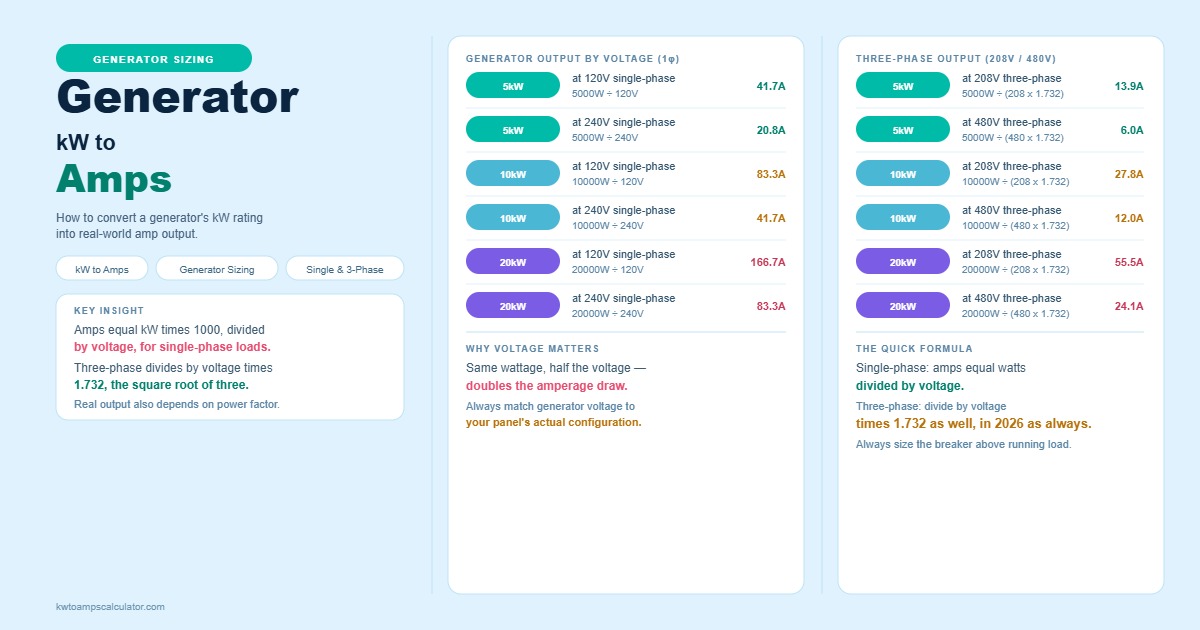
Table of Contents
- Electrical Fundamentals of Kilowatts and Amperes
- How to Convert kW to Amps for Single-Phase Generators
- How to Convert kW to Amps for Three-Phase Generators
- Quick-Reference Generator Amperage Chart
- How to Calculate Starting Versus Running Currents
- Sizing Backup Generators for Commercial and Industrial Needs
- Common Mistakes in kW to Amps Generator Calculations
- Frequently Asked Questions About Generator Current Sizing
To determine electrical current from a kW to amps generator, divide real power in kilowatts by system voltage multiplied by your circuit phase factor. A typical 5kW generator outputs 20.83 amps at 240 volts under single-phase conditions, while a 10kW system delivers 41.67 amps, and a 20kW commercial unit supplies 83.33 amps under identical voltage parameters. Sizing your electrical infrastructure requires precise calculations to match generator capabilities with real operational loads.
Electrical Fundamentals of Kilowatts and Amperes
Understanding electrical current requires a firm grasp of Ohm's law and basic power relationships. Real power measures the actual work done by an electrical system. Electricians express real power in kilowatts [kW], where one kilowatt equals exactly 1,000 watts. Conversely, amperes measure the physical flow rate of electric charge through a conductor over time. One ampere represents one coulomb of charge passing a specific point in exactly one second.
Voltage represents the electrical potential difference that drives this current through your system. You cannot calculate current draw without knowing your exact operating voltage. Sizable residential systems utilize standard split-phase configurations, while commercial complexes utilize complex multi-phase systems. Sizing generators requires comparing these metrics to protect appliances and heavy equipment.
System impedance and power factor modify these values in alternating current [AC] networks. Inductive equipment causes voltage and current waveforms to fall out of phase alignment. This misalignment increases the required apparent power to deliver identical real power. The ratio of real power to apparent power determines your efficiency. You must account for this difference to prevent overheating your distribution system.
The Crucial Role of Power Factor
Power factor measures the conversion efficiency of electrical current into useful work output. Purely resistive loads maintain a power factor of exactly 1.0. Inductive loads shift current behind voltage, reducing efficiency. Typical commercial generators operate at a standard power factor rating of 0.8. Sizing your system using a poor power factor results in higher amperage demands for the same kilowatt output.
Alternating Current Versus Direct Current Sizing
Direct current [DC] systems maintain a constant, unidirectional flow of electrical charge. Alternating current systems reverse the flow direction periodically at standard frequencies. DC conversions require simple division because no phase shifts exist. AC systems require complex calculations that include phase multipliers and power factors. You must identify your system type before selecting formulas.
How to Convert kW to Amps for Single-Phase Generators
To convert kilowatts to amperes on a single-phase AC circuit, multiply the power value by 1,000 and divide the product by the voltage multiplied by the power factor. Single-phase systems operate primarily in residential homes. Standard residential voltages measure 120 volts and 240 volts in North America. These units power basic appliances and lighting systems during power outages.
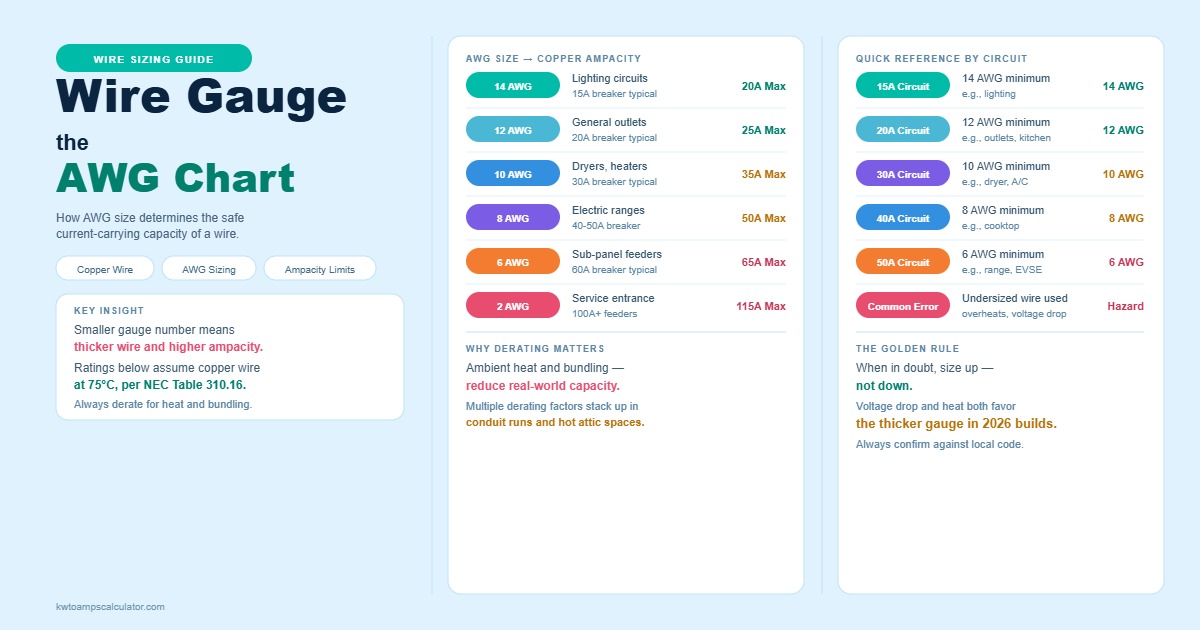
The mathematical formula for single-phase current calculation utilizes these parameters directly: Current (Amps) = (kW x 1,000) / (Voltage x Power Factor). If you use a resistive load, your power factor is 1.0. If you use motor-driven devices, your power factor is 0.8. Accurate voltage measurements ensure your calculated amperage matches real-world operating conditions.
Let us analyze a 5kW residential generator operating at 240 volts with a power factor of 1.0. First, multiply 5 by 1,000 to obtain 5,000 watts of real power. Next, multiply 240 volts by 1.0 to get 240. Finally, divide 5,000 by 240 to calculate exactly 20.83 amps of continuous current. This basic process applies to all single-phase calculations.
If you need to analyze systems in reverse, you can convert from Amps to kW using inverse mathematical formulas. Calculating inverse conversions allows you to verify your load requirements against your generator faceplate rating. Electrical safety margins dictate that you never load a generator past its maximum rated current limits.
How to Convert kW to Amps for Three-Phase Generators
To convert kilowatts to amperes on a three-phase AC circuit, multiply your power value by 1,000 and divide the product by the line-to-line voltage multiplied by the square root of 3 and the power factor. Three-phase systems support industrial machinery and heavy commercial facilities. These systems utilize three distinct alternating currents to deliver smooth, continuous power. Common commercial voltages measure 208 volts and 480 volts.
The mathematical formula for three-phase systems is: Current (Amps) = (kW x 1,000) / (1.732 x Voltage x Power Factor). The value 1.732 represents the square root of 3. This mathematical constant is necessary to balance the three vector currents. You must include this factor to calculate true physical current per phase in balanced networks.
Let us analyze a 10kW three-phase industrial generator operating at 480 volts with a power factor of 0.8. First, multiply 10 by 1,000 to get 10,000 watts. Next, multiply 1.732 by 480 volts and 0.8 to obtain 665.09. Finally, divide 10,000 by 665.09 to find exactly 15.04 amps of current per phase. Miscalculating this constant leads to severely undersized conductors.
When calculating systems with apparent power ratings, using kVA to amps conversions provides a more direct measurement path. Apparent power simplifies calculations by bypassing the power factor variable. Industrial engineers utilize apparent power to size physical transformers and switchgear. Matching these components correctly prevents voltage instability under peak loads.
Quick-Reference Generator Amperage Chart
This quick-reference reference table displays standard current conversions for common mobile and standby generators. All calculations assume a standard power factor of 0.8 for induction motor compatibility, representing standard generator duty cycles. Use these values to cross-reference your machinery requirements with your emergency backup systems.
|
Generator Size |
Voltage & Phase |
Current (Amps) |
Breaker Selection |
Wire Gauge (Copper) |
Difficulty Level |
|
5 kW |
120V Single-Phase |
52.08 A |
70 Amp Breaker |
4 AWG (21.1 mm²) |
Medium Sizing |
|
5 kW |
240V Single-Phase |
26.04 A |
35 Amp Breaker |
10 AWG (5.26 mm²) |
Simple Sizing |
|
10 kW |
240V Single-Phase |
52.08 A |
70 Amp Breaker |
4 AWG (21.1 mm²) |
Medium Sizing |
|
10 kW |
208V Three-Phase |
34.69 A |
45 Amp Breaker |
8 AWG (8.36 mm²) |
Complex Sizing |
|
20 kW |
240V Single-Phase |
104.17 A |
150 Amp Breaker |
1/0 AWG (53.5 mm²) |
Expert Sizing |
|
20 kW |
480V Three-Phase |
30.07 A |
40 Amp Breaker |
8 AWG (8.36 mm²) |
Complex Sizing |
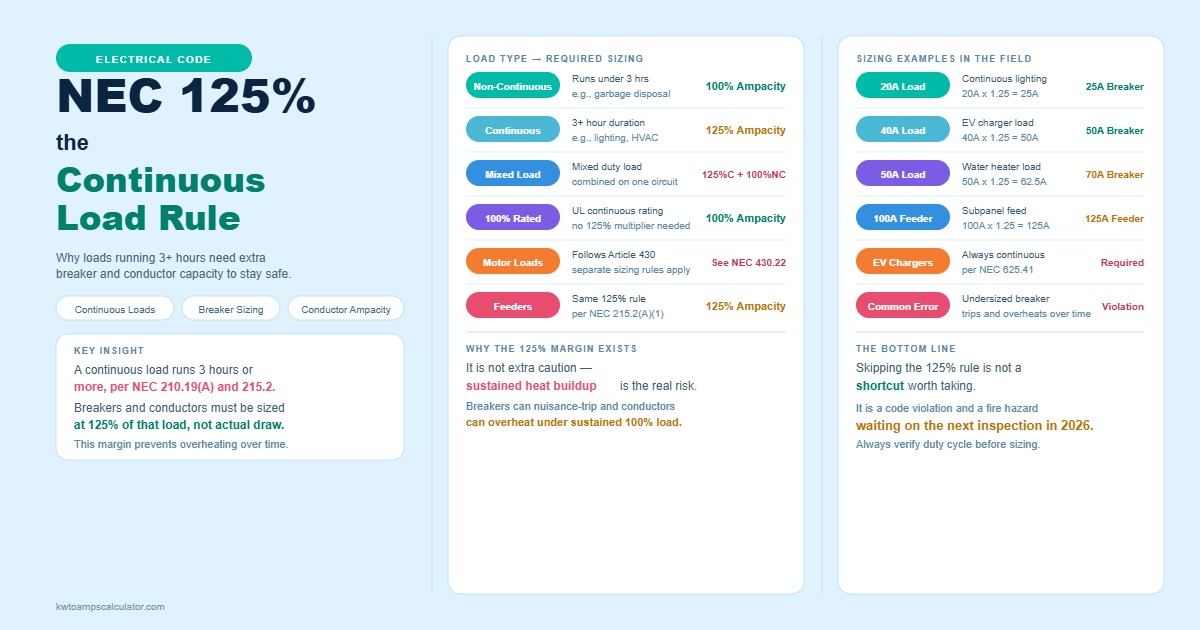
You must verify these values before implementing physical installations. The National Electrical Code [NEC] requires a 1.25 safety multiplier for all continuous duty applications. Sizing your electrical cables to handle maximum currents prevents fire hazards. Use copper conductors rated for your specific environmental conditions.
How to Calculate Starting Versus Running Currents
To calculate peak startup load current for electric motors, multiply the running amperes by a starting factor of 6. Induction motors draw significant power when accelerating from a stationary position. This short peak is called inrush current. Running current represents the continuous energy required to operate the motor at full speed.
The mathematical formula to determine peak starting current uses this relationship: Starting Amps = Running Amps x Inrush Factor. Typical air compressors and water pumps have an inrush factor of 6. If your system does not support this peak, your generator will stall. Sizing backup generators requires matching this peak load capacity.
Let us analyze a pump drawing 15 running amps. Multiply 15 amps by 6 to find exactly 90 starting amps. This high demand lasts for less than one second. If your generator cannot provide this instantaneous surge, your voltage will drop, causing safety switches to trip. Select a generator with adequate surge ratings to support motor starting.
Estimating Surge Capacity of Home Appliances
Home appliances require varying surge currents depending on motor design. Refrigerators and central air conditioners demand substantial startup currents. Sizing a backup generator without analyzing these surges leads to frequent blackouts. You must list the starting ratings of every motor load before finishing your sizing plan.
Selecting the Proper Circuit Breaker Sizing
Circuit breakers protect your wiring from carrying dangerous current loads. You must size breakers to handle continuous running currents and starting surges without nuisance tripping. Standard codes demand that your breaker rating exceeds your continuous calculated load. Select standard breaker sizes that match the calculated current of your system.
Sizing Backup Generators for Commercial and Industrial Needs
To size commercial standby generators properly, add your continuous loads to your starting surges and apply safety factors. Commercial facilities operate complex equipment with varying voltage requirements. Underestimating your total current causes system failures. You must perform detailed load audits to identify all active machinery.
The step-by-step process requires identifying the voltage of your main service panel. Commercial sites use 208 volts or 480 volts three-phase power. Convert each machine rating to current using the appropriate formulas. Calculate the total continuous current draw of your facility before adding the single largest motor starting surge.
Let us analyze a machine shop requiring 80 amps of continuous power. Multiply 80 amps by 1.25 to obtain exactly 100 amps for safety compliance. This matches standard safety margins. If you must run high wattage appliances like heaters or ovens, use Watts to Amps conversions to find individual branch circuit demands. Balancing these loads across all three phases prevents transformer failure.
Understanding Voltage Drop and Cable Lengths
Long cable runs increase the resistance of your distribution lines. This electrical resistance causes a physical voltage drop. Sizable voltage drops reduce the operational efficiency of your motors and appliances. You must select thicker copper conductors if your generator sits more than 50 feet (15.24m) from your panel.
Managing Non-Linear Loads and Harmonic Distortion
Modern computers and variable speed drives create non-linear electrical loads. These non-linear devices generate harmonic current distortion. Harmonic currents heat up generator windings, requiring you to oversize your generator system. You must specify premium alternators to handle these sensitive electronic loads safely.
Common Mistakes in kW to Amps Generator Calculations
To avoid common calculation errors, double-check your voltage levels and phase multipliers before finalizing designs. Many designers assume all home power uses 120 volts, forgetting that heavy appliances require 240 volts. This mistake doubles your calculated current draw, leading to dangerous undersizing.
Another frequent error is omitting the three-phase multiplier of 1.732 in commercial calculations. Omitting this constant results in calculated currents that are 42 percent lower than reality. These errors lead to selecting thin wire gauges, risking electrical fires. You must verify every phase rating using accurate documentation.
Let us look at a 10kW generator on a 208-volt system. If you forget the 1.732 constant, you calculate 48.08 amps. If you include the constant, you calculate exactly 27.76 amps per phase. This significant difference shows why mathematical precision is necessary. Always consult professional reference materials before buying expensive components.
Confusing Real Power with Apparent Power Ratings
Confusing real power [kW] with apparent power [kVA] is a common error. Real power represents work done, while apparent power represents total current delivered. Sizing systems using these units interchangeably causes severe system under-sizing. You must verify which metric your equipment nameplate lists before starting.
Neglecting local National Electrical Code Standards
Neglecting electrical code regulations leads to inspection failures and hazardous installations. The National Electrical Code [NEC] specifies strict spacing, grounding, and continuous load rules. Sizing your system without incorporating these legal standards is illegal. You must follow all guidelines to guarantee safety and compliance.
Frequently Asked Questions About Generator Current Sizing
This section answers your most common questions about converting generator power ratings into usable electrical currents. Clear answers help you design systems that are safe and reliable. Use these direct answers to verify your system plans before starting installation work.
How many amps does a 10kW generator produce at 240 volts?
Yes. A 10kW generator produces exactly 41.67 amps at 240 volts under single-phase conditions with a power factor of 1.0. If your power factor drops to 0.8, the same generator produces exactly 52.08 amps to support the increased current flow.
Can I run a 50-amp RV on a 10kW generator?
Yes. A 10kW generator provides up to 41.67 amps at 240 volts, which equates to two 50-amp lines of 120-volt power. This is sufficient because a standard 50-amp RV inlet requires two hot legs of 50 amps each.
Does three-phase power provide more amps than single-phase power?
No. Three-phase power delivers less current per individual conductor than single-phase power for a given kilowatt rating because it distributes the electrical load across three distinct phases instead of just one phase.
Is power factor important when sizing residential generators?
No. Residential generators support mostly resistive loads such as water heaters, meaning you can use a power factor of 1.0 for standard home calculations without risking system overload under normal operating conditions.
What size wire do I need for a 20kW generator at 240 volts?
Yes. You must use copper conductors rated for at least 1/0 AWG (53.5 mm²) to support the 104.17 amperes of continuous current produced by a 20kW generator under full load conditions at 240 volts.
To ensure complete safety and precision during system planning, utilize our specialized online tools. Finding the exact current ratings of your backup systems protects expensive equipment and prevents electrical hazards. Open our professional kW to amps generator calculator to input your specific system parameters and receive instant, certified sizing results today.

About Usman Haider
We are dedicated to providing accurate, easy-to-understand information. Our goal is to help you minimize effort and maximize results.